
B2B buyers in 2026 expect "consumer-simple" experiences, even when the reality behind the scenes involves contract pricing, complex account hierarchies, partial shipments, compliance documents, and multi-entity finance. The companies winning this decade are not just "adding ecommerce" or "launching a portal" — they are building frictionless B2B commerce ecosystems that connect every step of the journey, from quote to cash, across systems, teams, and partners.
A practical way to think about frictionless is this: customers can reliably do the top tasks (buy, track, pay, return, get help) with minimal effort, and your internal teams can fulfill those requests with minimal touches, exceptions, and reconciliation.
What “frictionless” really means in a B2B commerce ecosystem
In B2B, friction rarely comes from one broken screen. It comes from gaps between systems of record (ERP, CRM) and systems of engagement (web, portal, EDI, support), plus the manual work required to bridge those gaps.
A frictionless ecosystem has three outcomes:
- Fast paths for common work: reorders, repeat invoices, shipment tracking, RMAs, credit holds, and approvals follow predictable, guided flows.
- Exception handling that is intentional: when something is unusual (allocation, backorder, hazmat docs, disputed invoice), the handoff is routed with full context.
- Shared truth across the value chain: pricing, availability, order status, and invoices match what the ERP says, and updates propagate quickly to customers and customer-facing teams.
This is why “ecosystem” matters. You are not building a single app, you are building an operating environment.
The 2026 blueprint: 6 layers that make commerce feel effortless
Most mid-market teams already have the ingredients: an ERP (often NetSuite), a CRM, a website, maybe EDI, a shipping stack, and a support inbox. The difference is whether these pieces behave like a coherent system.
Here is a proven layered model you can use to design and govern your ecosystem.
| Layer | What it does | What “good” looks like in 2026 |
|---|---|---|
| Experience (web, portal, EDI, support) | Delivers guided workflows for buyers and internal teams | Task-first UX (reorder, pay invoice, track shipment), not ERP-first navigation |
| Identity and access | Controls who can see and do what | SSO where appropriate, delegated admin for customer accounts, least-privilege roles |
| Commerce data (product, pricing, terms) | Powers quoting and ordering consistency | One source of truth for SKU definitions, units of measure, contract pricing, tax rules |
| Orchestration and integration | Moves data and triggers workflows across systems | API-first integration, event-driven updates where possible, resilient retries and monitoring |
| Systems of record (ERP, CRM, WMS) | Holds financial and operational truth | ERP remains authoritative for orders, invoices, credit, inventory, and audit trails |
| Data, analytics, observability | Measures and improves performance | Instrumented journeys, integration health dashboards, root-cause visibility for exceptions |
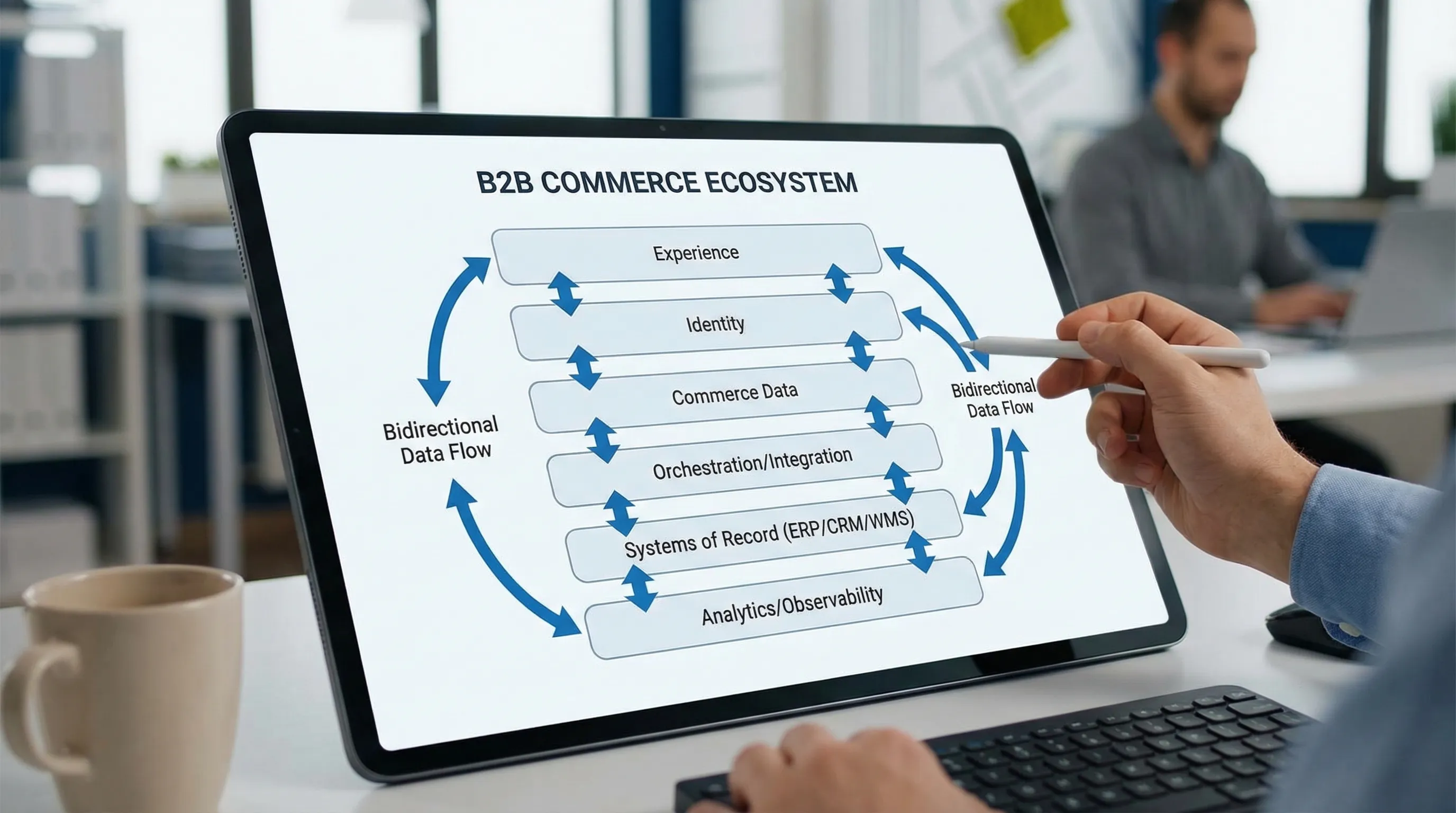
The steps below show how to operationalize this model — where to start, and in what order. If you design and build with these layers in mind, you can add capabilities (AI assistants, new channels, new fulfillment partners) without rebuilding everything.
Step 1: Pick the journeys that will define ROI (not the features)
Mid-market teams commonly lose time by starting with a feature list (portal, CPQ, punchout, EDI expansion). In 2026, the fastest way to value is to start with high-volume journeys and measure friction as cost.
Focus on “what happens most often” and “what creates the most rework”:
- Quote to order (including contract pricing and approvals)
- Order to shipment visibility (including partials and backorders)
- Invoice to cash (including disputes and collections workflows)
- Returns and credits (including eligibility rules and inspection outcomes)
- Case intake and status (support that can see ERP context)
A useful workshop output is a one-page “journey scorecard” per flow: volume per month, average touches, top exception types, time to complete, and dollars tied up (AR, credits, inventory).
Step 2: Create a “commerce data contract” between your front end and the ERP
Frictionless experiences die when the front end and the ERP drift apart. In practice, this shows up as:
- Customers seeing prices that do not match invoices
- “Available” inventory that is actually allocated
- Returns being promised that violate policy
- Orders being accepted without credit or compliance checks
In 2026, the pattern that works is a commerce data contract: an explicit definition of what data is exposed, at what freshness, with what rules, and with what fallbacks.
Your contract should define:
- Authoritative fields: what must always come from the ERP (terms, credit holds, open AR)
- Cached fields: what can be cached for speed and how long (tracking links, product images)
- Computed fields: what can be derived safely (ETA ranges, recommended reorder quantities)
- Policy checks: where approvals, compliance, and payment requirements are enforced
This is where many ecosystems get “quietly expensive”, because every undefined edge case becomes a ticket, a spreadsheet, and a meeting.
Step 3: Integrate for resilience, not just connectivity
A commerce ecosystem is only as strong as its integrations. The 2026 standard is not “we have APIs”, it is “we know when something breaks, and we recover cleanly.”
Design for these realities:
- Asynchrony happens: shipments update after orders, invoices post after fulfillment, credit memos lag returns.
- Failures are normal: rate limits, timeouts, malformed payloads, vendor downtime.
- Replays are required: you need idempotency (safe retries) and traceability.
If you are operating NetSuite as the system of record, two practical guardrails help:
- Keep financial posting logic in the ERP, and expose status outward.
- Put durable monitoring around integrations (alerts, dead-letter handling, and “what changed?” logs).
This is also a major unlock for AI automation. AI can triage and resolve exceptions, but only when the underlying integration layer is observable and well-governed.
Step 4: Make self-service real (guided tasks, not “ERP access”)
Many B2B portals fail because they give customers a mini-ERP. That is not self-service, it is self-navigation.
A frictionless ecosystem prioritizes task completion:
- Reorder from past purchases (with substitutions if discontinued)
- Pay invoices and download statements (with account hierarchy support)
- Track shipments and partials (with clear next steps on delays)
- Request RMAs (with eligibility rules and label generation)
- Manage users (delegated admin, roles, and approvals)
DataOngoing's VERSITAL portal platform is purpose-built for this model — configurable, NetSuite-native task flows without recurring licensing fees or custom code requirements. If you are evaluating whether your environment needs a purpose-built portal layer, DataOngoing's decision checklist on when you need a NetSuite portal is a helpful starting point.
If you are evaluating whether your environment needs a purpose-built portal layer, DataOngoing’s decision checklist on when you need a NetSuite portal is a helpful starting point.
Step 5: Connect fulfillment and logistics so “where is my order?” is effortless
In B2B, order visibility is not a nice-to-have. It directly impacts support load, customer trust, and cash collection.
To reduce friction, connect:
- ERP order and fulfillment status
- Warehouse events (pick, pack, ship)
- Carrier tracking and exceptions
- Customer notifications and ETAs
If you use a freight forwarder, warehousing partner, or 3PL, choose one that can support the modes and compliance requirements your customers expect.
The key is not the provider name — it is the integration posture: timely event feeds, consistent identifiers, and clear exception codes.
Step 6: Use AI to remove effort, with governance that protects the business
In 2026, AI is most valuable inside workflows, not as a standalone chatbot. The best commerce ecosystems use AI for:
- Case triage with ERP context: classify intent, pull order and invoice context, route correctly
- Document understanding: extract data from POs, bills of lading, and compliance docs
- Exception resolution: identify why an order is stuck (credit hold, allocation, missing info) and propose next actions
- Collections support: summarize account status, promised-to-pay, and dispute reasons
But AI must be governed. Treat AI as a production capability with clear boundaries, auditability, and escalation paths. If you need a practical governance anchor, the NIST AI Risk Management Framework (AI RMF) is a solid reference for organizing risk controls.
The simplest rule: AI can accelerate decisions, but the system of record should still own the final state changes (posting, approvals, financial commitments).
The operating model: why ecosystems fail without ownership
Even great builds degrade without an operating cadence. A frictionless ecosystem is a living product, and you need a way to:
- Prioritize the backlog based on ROI
- Run releases without breaking order-to-cash
- Monitor adoption, exceptions, and integration health
- Improve quarter over quarter as customer expectations shift
This is where managed services can outperform project-only consulting. With a managed approach, you can treat commerce as an ongoing operating system across ERP, integrations, AI automation, and digital experience, with predictable execution and measurable outcomes.
If you are exploring that model, DataOngoing also publishes practical guidance on evaluating partners in the NetSuite managed service partner guide for 2026.
Metrics that prove you are actually becoming frictionless
Frictionless is measurable. The trick is choosing metrics that represent both customer effort and internal effort.
| Area | Metrics to track | Why it matters |
|---|---|---|
| Customer experience | Self-service adoption rate, time to complete top tasks, repeat contacts per order | Shows whether customers can get work done without help |
| Operations | Touches per order, exception rate, order cycle time, return cycle time | Quantifies internal labor and variability |
| Finance | Days sales outstanding (DSO), dispute rate, time-to-cash after delivery, unapplied cash | Connects experience quality to cash flow |
| Reliability | Integration error rate, mean time to detect and recover, SLA adherence | Prevents silent failures from becoming revenue leakage |
| Growth enablement | Conversion rate on reorder flows, quote win rate, onboarding time for new accounts | Ties ecosystem improvements to revenue outcomes |
Once these are instrumented, you can run high-confidence optimization cycles: pick one journey, remove one friction point, measure the delta.
Common pitfalls (and how to avoid them)
Most “frictionless” programs stall for predictable reasons:
- Treating the portal as the strategy: a portal is a channel, not the ecosystem.
- Customizing the ERP to match old workarounds: you scale legacy complexity.
- Ignoring account hierarchies and delegated admin: adoption drops fast.
- Shipping integrations without observability: you only learn about failures from customers.
- Adding AI without data contracts and guardrails: you create risk, not leverage.
Avoid these by insisting on outcome-based scope, clear data ownership, and an operating model that can sustain improvement.
Frequently Asked Questions
What is a frictionless B2B commerce ecosystem? A connected set of systems and workflows (web/portal, ERP, CRM, integrations, fulfillment, support) that lets customers complete key tasks with minimal effort while reducing internal touches and exceptions.
Do I need to replace my ERP to build a frictionless experience? Usually not. Many mid-market teams keep the ERP as the system of record and modernize the experience layer, integrations, and workflow automation around it.
Where should we start if we have multiple channels (sales reps, EDI, portal, distributors)? Start with one or two high-volume journeys (often invoice-to-cash and order visibility), define a shared data contract, and standardize statuses across channels.
How does AI help B2B commerce in 2026 without adding risk? AI helps most when it is embedded in workflows (triage, document extraction, exception handling) with least-privilege access, audit trails, and human escalation, while the ERP controls final posting and approvals.
What KPIs best show progress toward frictionless? Track self-service adoption, touches per order, exception rate, order cycle time, dispute rate, and integration reliability (error rate and time to recover).
Build a commerce ecosystem that runs, not just one that launches
If your team is juggling manual order fixes, “where is my order?” tickets, pricing disputes, and brittle integrations, you do not have a channel problem. You have an ecosystem problem.
DataOngoing helps mid-market companies design, integrate, and operate frictionless B2B commerce ecosystems across ERP (including NetSuite), AI automation, unified integrations, and digital experience, with a managed service approach focused on measurable ROI. If you want a practical plan for your next 90 days, start with a discovery conversation at DataOngoing.
DataOngoing Team
AI-First Managed Service Provider
DataOngoing helps mid-market companies achieve measurable ROI through AI automation, ERP expertise, and digital transformation.