
Your ERP is the operational backbone of your business, but growth rarely happens in a straight line. New channels come online, acquisitions add complexity, and customer expectations shift faster than roadmaps. The question is not whether your ERP can scale, it is whether your IT service solutions scale with it, reliably and cost effectively.
This guide shows mid-market leaders how to build an ERP-aligned IT services strategy that scales without chaos. You will learn the architectural patterns, governance practices, and practical use cases that unlock measurable ROI, with a special focus on NetSuite environments.
What "scaling with your ERP" really means
Scaling is more than adding users or turning on a new module. It is about coordinated capability across five pillars that grow in lockstep with the business:
- Integration layer: API-first connections and event flows between ERP and key systems without point-to-point sprawl.
- Data and analytics: Clean, governed, and timely data modeled for decisions, not just reports.
- Process automation: Orchestration that spans ERP, CRM, commerce, finance, and ops with human-in-the-loop where needed.
- Digital experiences: Websites, portals, and partner tools that reflect real-time ERP truth, including pricing, inventory, and order status.
- Reliability and governance: Security, observability, change control, and documentation that keep everything trustworthy at scale.
When these pillars mature together, you shorten cycle times, reduce rework, and free teams to focus on high-value work.
A scalable blueprint, from integration to insight
This is what a well-architected ERP ecosystem looks like. The gap between this and what most organizations actually have is where integration projects stall, budgets balloon, and technical debt compounds.
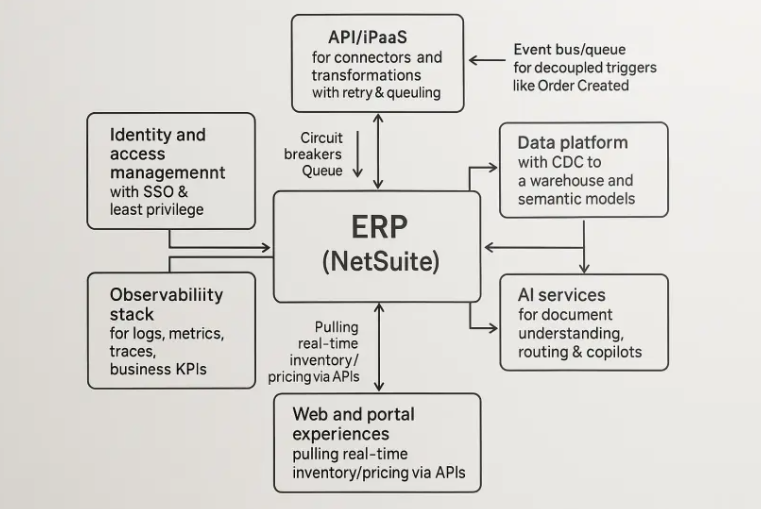
Key architectural principles:
- Event-driven, not batch-first: Publish business events like Order Created or PO Received so downstream systems act immediately, with retries and dead-letter queues for resilience.
- API-first integrations: Use versioned APIs with schema contracts and rate-limit guards. Follow secure patterns from the OWASP API Security Top 10.
- Data replication and modeling: Use change data capture to move approved ERP objects to a warehouse for analytics, forecasting, and AI features. Model semantic layers for finance, supply chain, and revenue.
- Observability and SLOs: Monitor not only uptime but also business SLAs such as "orders synced within 3 minutes" and "invoices posted within 5 minutes."
- Dev/test/prod and CI/CD: Treat SuiteScript, integrations, and data pipelines as code. Use branch strategies, automated tests, and controlled releases.
For NetSuite, the SuiteCloud platform provides the foundation for extensibility, including SuiteScript, SuiteFlow, and deployment tooling. A disciplined approach here prevents brittle customizations and accelerates reliable change.
NetSuite-specific patterns that scale
Every ERP has its own strengths and guardrails. In NetSuite environments, the following patterns help you scale predictably:
- Prefer REST for new builds, use SOAP where required by module limits or legacy constraints.
- Use Saved Searches or queries for incremental reads, rather than full-table polling.
- Break heavy workloads into Map/Reduce or scheduled tasks, respect governance units, and design with idempotency so retries are safe.
- Adopt environment strategy early, keep custom objects and scripts versioned and deploy through controlled pipelines.
- For analytics, sync sanctioned objects to your warehouse and keep transformations transparent and testable.
These practices reduce timeout risk, ease deployments, and make integrations more maintainable as volumes grow.
Where AI belongs in an ERP-centered stack
AI should amplify, not override, your ERP. The winning approach uses AI as a set of focused services with clear guardrails:
- Document understanding for AP and AR: Extract data from invoices or statements, validate against ERP POs or customer records, and route exceptions with human approval.
- Intelligent triage in operations and CX: Summarize cases, suggest next actions based on ERP context, and auto-populate forms to reduce handle time.
- Natural-language insights: Allow stakeholders to ask questions like "What delayed shipments are at risk of missing quarter-end?" over governed data models.
- Sales enablement: Draft quotes or proposals using ERP-approved pricing and inventory, then route to a rep for finalization.
Anchor AI initiatives to a risk framework such as the NIST AI Risk Management Framework. Keep training and prompts bounded to approved, non-sensitive sources, and log decisions for auditability.
Avoid the common scaling traps
Many mid-market teams hit the same roadblocks:
- Point-to-point sprawl: Direct connections between every system pair make change risky and slow.
- Script creep: Ad hoc scripts without tests or documentation that break silently under load.
- Reporting debt: Teams build spreadsheets off exports, which drift from ERP truth and delay decisions.
- Environment drift: Dev, test, and prod behave differently, which leads to release failures.
- Invisible failures: Integrations fail quietly, operations find out when customers complain.
The cure is a shift to platform thinking, where integrations, data, automation, and governance are managed services with lifecycle ownership.
From idea to impact, fast and safely
A practical way to get moving is a phased path that demonstrates value quickly while laying scalable foundations:
1. Assess and prioritize: Map business processes to systems, identify high-friction handoffs, and rank by ROI potential and implementation effort.
2. Establish core plumbing: Stand up the integration layer with queues and retries, implement identity controls, and enable basic observability.
3. Deliver high-ROI use cases: Automate one order-to-cash handoff, stand up invoice capture to ERP validation, or sync inventory to the web store in near real time.
4. Expand and standardize: Codify patterns, templates, and runbooks so every new integration follows the same rules and monitoring.
Teams see benefits in weeks, with compounding returns as the blueprint is reused.
Metrics that prove scaling is working
Tie every initiative to measurable outcomes. The table below maps common mid-market use cases to ERP touchpoints and the KPIs that show value.
| Business capability | ERP touchpoint | IT service solution | Primary KPI | Expected effect |
|---|---|---|---|---|
| Order-to-cash | Sales orders, invoices, payments | Event-driven integration between commerce, ERP, and payment gateway with automated reconciliation | Days Sales Outstanding (DSO) | Lower |
| Procure-to-pay | POs, receipts, vendor bills | AI invoice capture with ERP validation and exception routing | First-pass match rate | Higher |
| Inventory accuracy | Items, bins, transfers | Bi-directional sync with warehouse and ecommerce platforms | Inventory variance | Lower |
| Customer experience | Customer records, cases | Unified CRM-ERP view with AI-assisted case routing | First contact resolution | Higher |
| Financial close | GL, consolidation, reporting | Automated reconciliation and governed reporting models | Days to close | Fewer |
For process scoping, many teams use the APQC Process Classification Framework to standardize vocabulary and measurement.
Security, compliance, and reliability by design
Security and reliability are not nice-to-haves when you integrate critical finance and operations systems.
- Identity and access: Centralize SSO, rotate credentials, and enforce least-privilege policies for every integration user and API key.
- Data protection: Classify data, encrypt in transit and at rest, and plan for data residency where applicable.
- Change control: Use pull requests, peer review, and automated testing for scripts and pipelines.
- Runtime safety: Implement circuit breakers, exponential backoff, and dead-letter queues. Alert on both technical failures and business SLO breaches.
- API hygiene: Validate inputs, paginate reads, and throttle requests. Follow the OWASP API Security Top 10.
These controls keep auditors, customers, and executives confident as you scale.
When a managed service beats building it all in house
Mid-market teams often do not have the headcount to field specialists across ERP, integration, data engineering, security, AI, and web. A managed service model gives you a cross-functional bench, unified tooling, and predictable costs.
With DataOngoing, you get:
- AI automation and assistants aligned to ERP truth
- ERP integration expertise with unified system integrations
- AI-accelerated web development and data-driven digital marketing that reflect real-time ERP data
- Fixed monthly pricing, enterprise reliability, and a proven ROI focus
- A scalable partnership that keeps your systems future-proof as the business evolves
This approach eliminates integration sprawl, improves time-to-value, and reduces the total cost of ownership compared with ad hoc projects or pure staff augmentation.
Readiness checklist
Use this quick self-check to gauge where to start:
- We can trace every integration to a clear owner, runbook, and monitoring dashboard.
- We have separate dev, test, and prod, and we deploy ERP scripts and integrations through a controlled pipeline.
- Our reporting is primarily from governed models, not spreadsheets off exports.
- We alert on business SLOs, for example, order sync time, not only on server health.
- We can list the top three processes where automation would create the most value this quarter.
If you answered no to two or more, begin with integration resiliency and observability, then deliver one high-ROI use case to build momentum.
Frequently Asked Questions
Does this approach only apply to NetSuite?
The patterns apply to any modern ERP. We reference NetSuite because many mid-market companies run it, and SuiteCloud provides strong extensibility, but event-driven integration, CI/CD, and data governance are ERP-agnostic.
Do we need an iPaaS to scale?
Not always, but it helps. An iPaaS gives you connectors, retries, monitoring, and governance out of the box. Teams with limited integration engineering capacity often reach value faster with an iPaaS than with custom code alone.
Will AI tools conflict with our ERP customizations?
They should not if implemented as services that read approved data and write back through controlled APIs with validations. Keep humans in the loop for sensitive actions and log decisions for auditability.
How do we avoid breaking changes when ERP data or APIs evolve?
Use versioned API contracts, schema registries, and consumer-driven contract tests. Changes then roll out safely behind feature flags and release windows.
What is the fastest path to ROI?
Start with one high-leverage handoff in order-to-cash or procure-to-pay, where latency and manual work are most visible. Prove the outcome, then scale the same pattern to adjacent processes.
How do we measure success beyond uptime?
Track business KPIs such as order sync latency, invoice first-pass match rate, DSO, days to close, inventory variance, and case deflection. Tie each initiative to a baseline and a target.
Talk to DataOngoing
If you are ready to align IT service solutions with your ERP and scale without chaos, DataOngoing can help. Our managed service blends AI automation, NetSuite ERP expertise, unified integrations, AI-accelerated web development, and data-driven digital marketing. With fixed monthly pricing, enterprise reliability, and a proven ROI focus, we help mid-market companies build future-proof systems that grow with the business.
Start the conversation and explore a roadmap tailored to your operations. Talk to an expert at DataOngoing.
DataOngoing Team
Technology Consulting Experts
DataOngoing helps mid-market companies achieve measurable ROI through AI automation, ERP expertise, and digital transformation.