
Pressure on support teams has never been higher. Customers expect instant answers, accurate resolutions, and empathy. Leaders expect lower cost to serve. Service AI promises relief, yet many programs stall because they erode trust or feel robotic. The path forward is a hybrid model where AI automates the right moments, and humans remain visible owners of the relationship.
Two data points frame the opportunity and the guardrails:
- A large-scale field study found generative AI lifted customer support agent productivity by an average of 14 percent, with the biggest gains for less-experienced agents, because AI reduced search and drafting time while standardizing quality (NBER Working Paper w31161, 2023).
- McKinsey estimates generative AI could increase productivity in customer operations by a value of 30 to 45 percent of current function costs — primarily through self-serve guidance, agent assist, and workflow orchestration. The rest still benefits from human judgment and accountability.
When you design Service AI to enhance, not replace, human service, you get faster answers that still feel like your brand.
What Service AI is, and what it is not
Service AI is a set of capabilities that use language models and automation to understand intent, retrieve knowledge, perform simple transactions, and keep humans in the loop. It is not a license to replace human judgment, ignore edge cases, or let models improvise policies.
A practical definition that works for mid-market teams:
- Understand: classify intent, detect sentiment, extract key data from messages.
- Guide: ask clarifying questions, propose next steps, draft empathetic replies.
- Act: trigger approved actions, for example check order status, reschedule delivery, create RMA, request invoice copy.
- Escalate: hand off to a person when confidence or permissions are low, provide a clean summary and suggested next step.
The human standard, non-negotiables you protect
To automate without losing the human, codify these principles up front and make them testable:
- Empathy and tone that match your brand, especially when customers are frustrated.
- Accountability that is clear to customers, AI can assist, and a person owns the outcome.
- Transparency, disclose when AI is responding or assisting, and make opting out easy.
- Privacy by design, limit, mask, and log access to PII and financial data.
- Escalation on uncertainty, safety, compliance, VIP status, or repeated customer effort.
Where automation fits first: a use case map
Start where rules are clear, data is reliable, and the outcome is low risk. Expand to higher-complexity flows once you have measurement and governance in place.
| Use case | Typical data needed | Automation level | Human role | Primary KPI |
|---|---|---|---|---|
| Order status and delivery ETA | ERP sales order, shipment, carrier | Autoresolve, with confirmation | Review exceptions | First contact resolution, containment rate |
| Invoices and payment receipts | ERP AR records, PDFs | Autoresolve | Audit and dispute handling | Time to document, CSAT |
| Returns and RMAs | ERP item, reason codes, policy | Copilot drafts plus human approval | Final approval, fraud checks | Handle time, error rate |
| Product how-to and troubleshooting | Knowledge base, past cases | Mixed, AI proposes steps | Validate steps, edge case handling | Time to resolution, reopen rate |
| Contract questions and pricing | CRM, CPQ, policy | Assist only | Own decision, negotiate | CSAT, compliance flags |
Mid-market teams running NetSuite often unlock quick wins on order lookups, invoice copies, and simple returns because data is normalized and permissions are clear.
An architecture that keeps humans in the loop
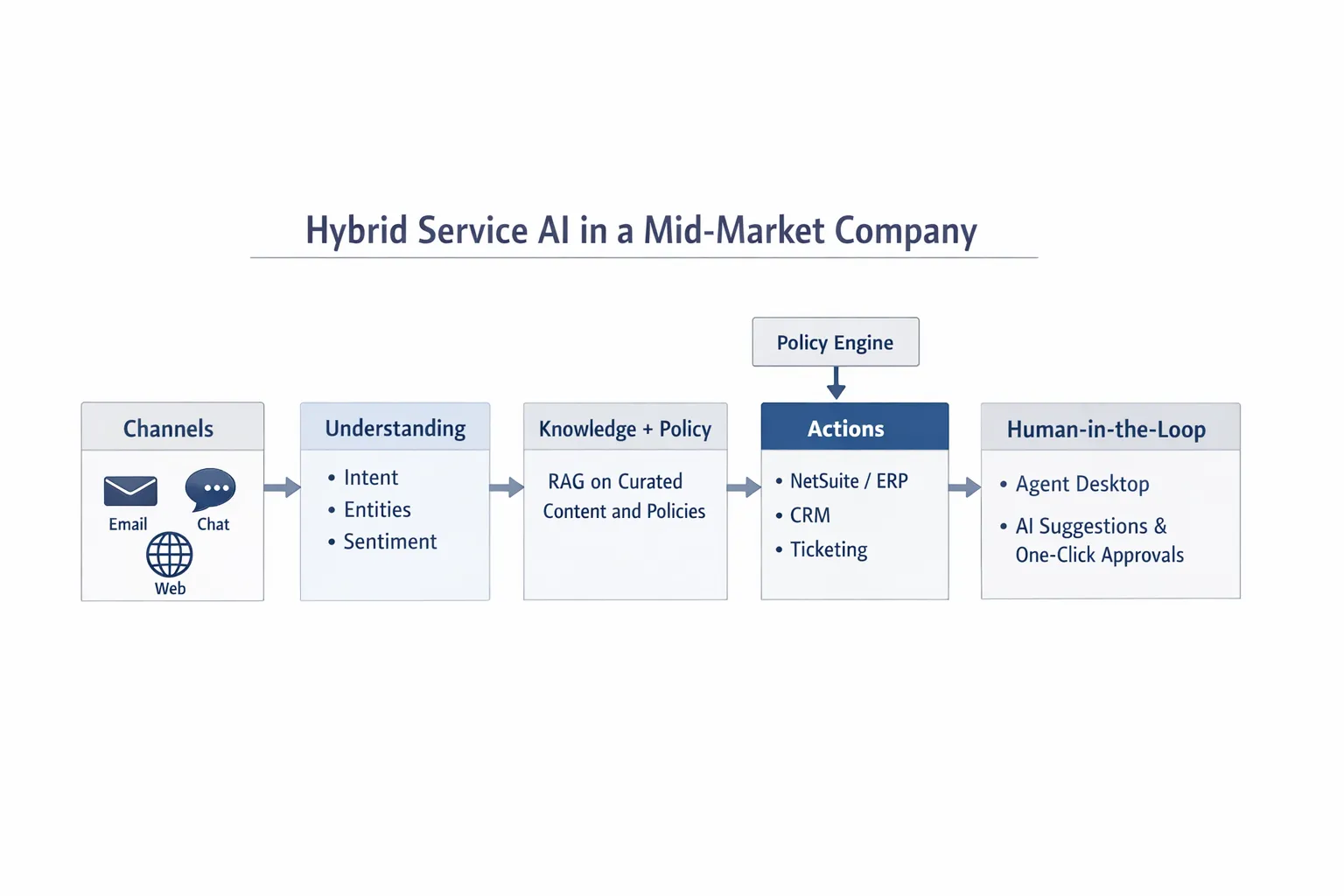
Service AI is more than a chatbot. A resilient pattern for mid-market environments ties your ERP and CRM into a governed workflow.
- Channel ingestion, email, chat, web forms, and voice transcripts normalize into a case object.
- Intent and entity extraction, models classify issue type, urgency, sentiment, and pull order IDs or invoice numbers from text.
- Retrieval augmented generation, the assistant pulls only approved knowledge, policies, and case history to compose a safe response.
- Action layer, callable functions perform approved tasks, for example NetSuite queries or case updates, behind a policy engine that checks permissions and confidence.
- Human-in-the-loop, when thresholds fail or customer requests it, route to an agent with a prefilled summary, disposition guess, and suggested next step.
NetSuite integration notes
- Use read-only functions for early pilots, for example saved searches or REST roles scoped to orders and invoices.
- For write actions like RMA creation, require human approval or two-factor confirmation inside the agent desktop.
- Manage concurrency and governance limits, batch non-urgent reads and cache stable lookups like policy texts.
- Log every model prompt, retrieved source, and system action for audit. Store only what policy allows, mask PII wherever possible.
If you are evaluating your ERP integration strategy, this complements the guidance in our post on IT service solutions that scale with your ERP.
Design patterns that make automation feel human
Small interaction details change how customers feel about automation. Bake these into flows.
- Clarify before you guess, ask one targeted question to improve accuracy, for example “Do you want the latest invoice for PO 10482 or a statement for the full account?”
- Confirm actions, restate what will happen and ask for consent, for example “I can create an RMA for 2 units of SKU-184, return method email label, proceed?”
- Summarize and hand off cleanly, when escalating, give the agent a crisp brief, “Customer needs exchange, not refund, order 65421, damaged on arrival, photo attached, offered 15 percent discount.”
- Keep brand voice consistent, tune prompts with examples from your best agents. Short sentences reduce model drift and speed reading.
- Be honest about limits, “I do not have permission to cancel orders, I have sent this to a specialist and you will hear back by 4 pm Eastern.”
Metrics that prove you did not lose the human
Measure customer effort and quality, not just deflection. Track by segment and channel, because automation can hide problems in averages.
| Metric | Why it matters | Healthy direction |
|---|---|---|
| First contact resolution (FCR) | Reduces effort and cost | Up |
| Containment rate | Share of issues resolved without human, excluding misroutes | Up, with stable CSAT |
| CSAT by automation type | Quality signal from customers | Stable or up |
| Average handle time (AHT) | Efficiency for human-handled cases | Down |
| Reopen and transfer rate | Proxy for quality and clarity | Down |
| Policy violations and safety blocks | Guardrail health | Low and trending down |
A simple ROI lens for CFOs: annual savings roughly equals, contacts deflected times cost per contact plus agent time saved from AHT reduction times fully loaded cost per hour, minus program costs. For a deeper framework, see our guide, Managed service ROI, a practical guide for CFOs.
A 90 day plan for mid-market teams
Month 1, foundation
- Map top 20 intents, volumes, and pain, from last 6 to 12 months of tickets.
- Curate a trusted knowledge base, prioritize return policies, invoice instructions, shipping rules, and how-to steps. Remove conflicting content.
- Launch agent assist only, summaries, suggested replies, and reference snippets in the agent desktop. No customer-facing bot yet.
Month 2, customer-facing for low-risk intents
- Turn on customer automation for order status and invoice re-send, with explicit confirmations and easy opt-out to human.
- Measure containment, CSAT, and false positives daily. Add a visible switch to reach a person.
- Introduce action approval flows, allow the bot to draft RMAs and credit memo requests, agents click to approve.
Month 3, expand and harden
- Add troubleshooting flows for the top three product issues, tune clarifying questions with examples from resolved cases.
- Implement model and policy audits, random samples split by intent, channel, and customer segment.
- Publish a short policy that explains where AI is used and how to get human help quickly.
This sequence reduces risk and builds trust inside your team and with customers.
Governance you actually use
Good governance is practical, lightweight, and visible to the people doing the work.
- Data minimization, limit what models can see, mask PII and financial data by default.
- Zero retention with external model providers where possible, or bring models to your data.
- Evaluation harness, maintain a living set of real, de-identified tickets to regression test quality after every change.
- Human approval thresholds, enforce category-based gates, for example any monetary adjustment needs a person.
- Incident playbook, define how you roll back a model, switch to safe mode, or pause certain intents.
For a broader framework, align your practice with the NIST AI Risk Management Framework, which focuses on transparency, fairness, and security.
A NetSuite-centric playbook for common service tasks
Many mid-market teams run service on top of NetSuite, or they rely on it for the truth about orders, inventory, and invoicing. Here is how Service AI fits without custom sprawl.
- Order status, expose a read-only function that maps a customer’s email and order number to a NetSuite sales order, then combine shipment and carrier data into a single, plain-language answer. Cache non-sensitive fragments like carrier ETA translations.
- Invoice copy and statement, retrieve PDFs from the file cabinet or generate on demand, then email with account masking where needed. Log the action to the case, including the document ID.
- RMA drafting, the assistant collects reason codes, quantities, and photos, drafts an RMA in a pending state, and routes to a queue with policy checks on window, serial numbers, and fraud flags. Agents approve, AI sends the label and instructions.
- Subscription or contract questions, let the assistant draft an explanation by pulling terms from a controlled template and the contract line items, then require a person to approve any change or credit.
If the built-in portal falls short for these flows, assess gaps and fixes with our analysis of NetSuite customer portal limitations and mid-market fixes. For performance considerations on customizations that touch cases and forms, review our guide to proven NetSuite UI fixes for mid-market teams.
Team design and change management
People make or break Service AI. Treat it as a capability, not a project.
- Upskill agents into specialists and coaches, give them tools to flag patterns, propose new intents, and fix content.
- Create a small service engineering pod, a product owner, an automation engineer, and a QA lead can manage a lot of value.
- Calibrate weekly, sample escalations together, tune prompts, update policies, and celebrate cases where AI reduced customer effort.
How DataOngoing helps mid-market leaders land Service AI
Mid-market companies need outcomes, not another platform to manage. DataOngoing’s managed approach combines AI automation, ERP integration expertise, and data-driven iteration so your team sees measurable ROI without sacrificing trust or control.
- We start with your top contact drivers and policy guardrails, then ship agent assist in weeks, not months.
- We integrate with your ERP and systems of record securely, so actions like order lookups and RMA creation are accurate and auditable.
- We run continuous improvement, from evaluation sets and QA calibration to content governance and performance tuning.
Explore how we think about partner models and value delivery in our posts on what a managed partner brings to mid-market teams and why a partner-first strategy wins in 2026. For an AI-specific lens on the year ahead, see what to expect from an AI company in 2026.
Sources
- Generative AI at Work: Evidence from a Call Center, NBER Working Paper w31161, Erik Brynjolfsson, Danielle Li, Lindsey R. Raymond, 2023. NBER
- The economic potential of generative AI, McKinsey, 2023. McKinsey
- AI Risk Management Framework 1.0, National Institute of Standards and Technology, 2023. NIST
Ready to automate support without losing the human? Reach out to DataOngoing to scope a focused 90 day program that proves value, protects your brand, and sets up scalable growth.
DataOngoing Team
AI-First Managed Service Provider
DataOngoing helps mid-market companies achieve measurable ROI through AI automation, ERP expertise, and digital transformation.