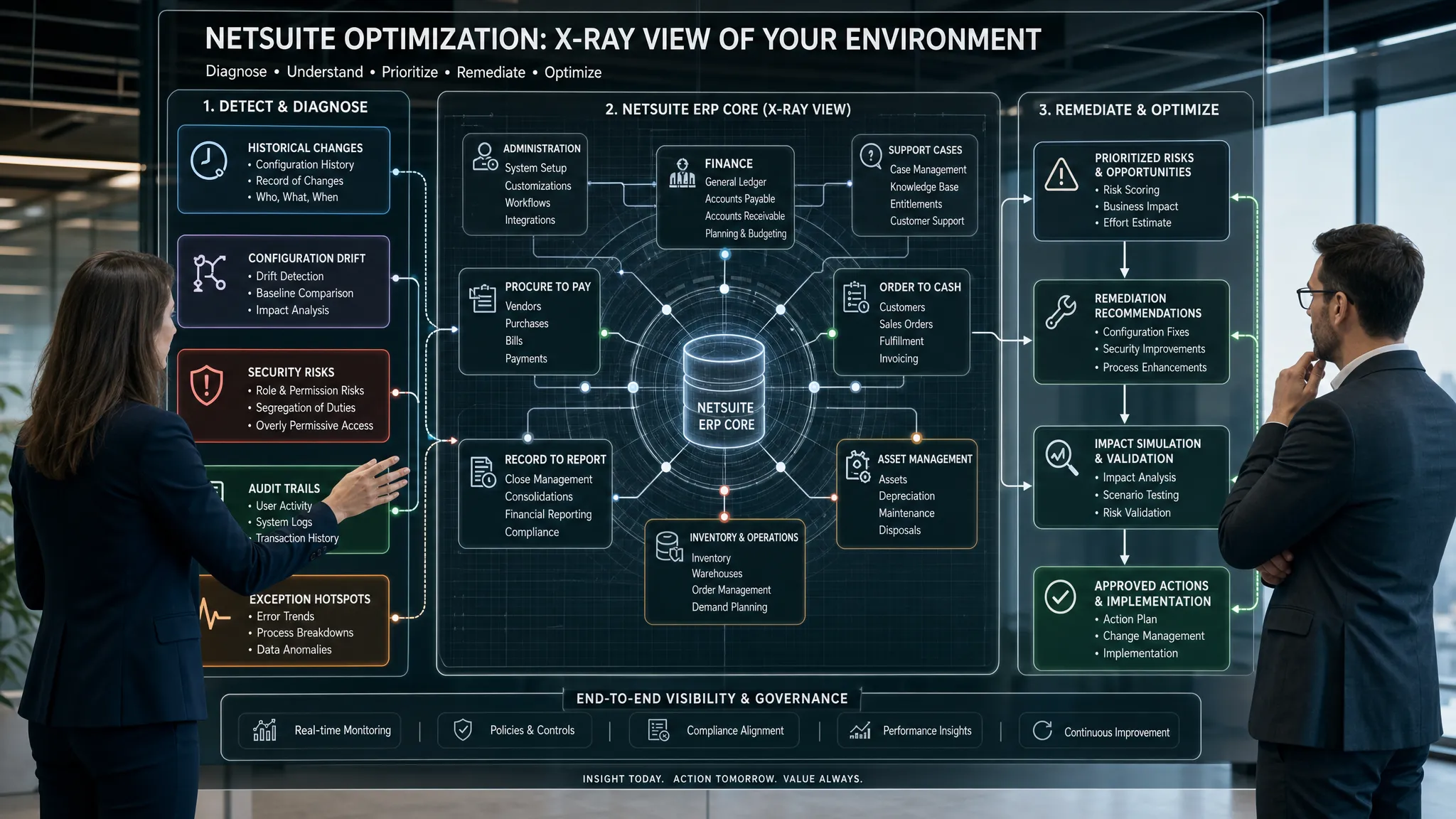
AI business software is no longer a side experiment for technical teams. For mid-market companies, it is becoming a practical operating layer that helps teams close the books faster, respond to customers sooner, reduce manual errors, and make better decisions with the data they already have.
The difference between useful AI and expensive AI is operational fit. A chatbot that answers general questions may be interesting. AI business software that reads an incoming purchase order, checks it against inventory and credit rules, updates the ERP, flags exceptions, and routes approvals is operationally valuable.
That is where ROI comes from. Not from novelty, but from compressing cycle time, increasing throughput, improving accuracy, and giving people better information at the point of work.
What AI business software means in a real company
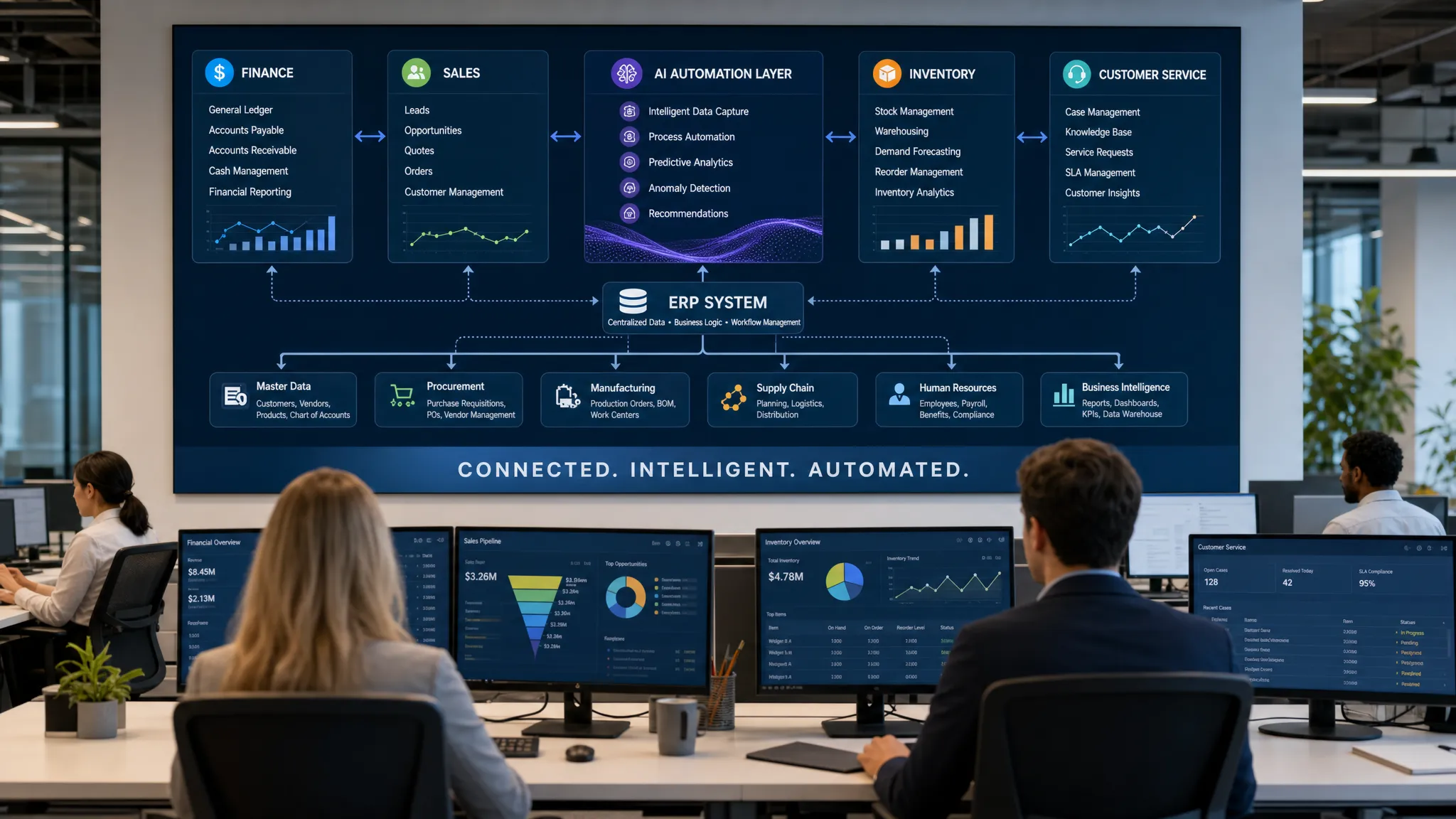
AI business software combines automation, analytics, and intelligent assistance inside everyday workflows. It can sit within existing platforms such as ERP, CRM, ecommerce, finance, support, and marketing systems, or it can connect across them through integrations.
For mid-market companies, the best use cases usually involve processes that are important, repetitive, data-heavy, and constrained by human review. These are the workflows where employees spend too much time copying data, reconciling records, answering the same questions, chasing approvals, or finding the right information across disconnected systems.
In practical terms, AI business software can help with:
- Extracting information from invoices, emails, support tickets, orders, contracts, and forms
- Matching records across ERP, CRM, warehouse, and finance systems
- Recommending next actions based on policies, history, and business rules
- Summarizing customer, vendor, project, or account context for faster decisions
- Detecting anomalies before they become costly operational problems
- Automating routine communications while escalating exceptions to the right person
This is why AI adoption should start with workflows, not tools. If the software does not connect to the systems where work happens, the team still has to bridge the gap manually. That limits ROI and often creates a new layer of work instead of removing one.
How AI business software improves operations
The most visible benefit is speed, but speed is only one part of the story. Strong AI implementations improve operations across several levers at the same time.
| Operational lever | How AI business software helps | Example business impact |
|---|---|---|
| Cycle time | Automates handoffs, data entry, routing, and first-pass review | Faster quote-to-cash, order processing, and month-end close |
| Accuracy | Reduces manual rekeying and flags inconsistent records | Fewer billing errors, duplicate records, and fulfillment issues |
| Visibility | Summarizes trends and exceptions across connected systems | Earlier awareness of margin pressure, delays, and demand changes |
| Throughput | Lets teams process more work without adding proportional headcount | More tickets, invoices, orders, or campaigns handled by the same team |
| Decision quality | Provides context, recommendations, and scenario analysis | Better pricing, purchasing, prioritization, and customer decisions |
The key is that these improvements compound. A finance team that receives cleaner order data can invoice faster. Faster invoicing improves cash flow. Better cash flow reduces time spent on collections. Reduced collections workload frees people to focus on higher-value analysis.
That chain reaction is often where the real ROI appears.
Why ROI is bigger than labor savings
Many leaders first evaluate AI business software through the lens of time saved. That is useful, but incomplete. Labor efficiency is only one ROI category.
The stronger business case usually includes four types of return.
Cost reduction comes from eliminating repetitive manual work, reducing rework, and lowering the cost of processing transactions. This may include fewer hours spent on invoice coding, customer support triage, report preparation, or data cleanup.
Revenue lift comes from faster follow-up, better lead prioritization, improved customer responsiveness, and more consistent sales or account management execution. For example, an AI assistant that summarizes account history before a renewal call can help reps focus on the right risks and opportunities.
Working capital improvement comes from better forecasting, faster billing, fewer stockouts, and more accurate purchasing. In inventory-heavy businesses, even a small improvement in demand planning can have meaningful financial impact.
Risk reduction comes from fewer compliance misses, better audit trails, improved data consistency, and faster anomaly detection. Risk reduction can be harder to quantify, but it matters when errors affect customers, margins, or financial reporting.
McKinsey has estimated that generative AI could add $2.6 trillion to $4.4 trillion in annual economic value across business use cases. For an individual company, the relevant question is not how large the global opportunity is. The relevant question is which workflows can turn AI capability into measurable operating improvement.
A simple ROI model for AI business software
AI ROI should be measured before and after implementation, using baseline operating metrics. The goal is not to create a perfect business case on day one. The goal is to connect automation to financial outcomes clearly enough that leaders can decide where to invest next.
A simple model looks like this:
AI ROI = (annualized benefit - annualized cost) / annualized cost x 100
Annualized benefit may include time savings, fewer errors, increased revenue, reduced churn, lower outsourcing costs, or reduced working capital requirements. Annualized cost should include software, integration, implementation, change management, maintenance, and internal time.
| ROI input | What to measure | Why it matters |
|---|---|---|
| Baseline volume | Monthly invoices, orders, tickets, leads, reports, or tasks | Shows the size of the automation opportunity |
| Current cost per process | Labor time, vendor costs, rework, and system costs | Establishes the financial baseline |
| Error and exception rate | Reversals, duplicates, escalations, delays, and missed steps | Quantifies quality improvement |
| Cycle time | Time from request to completion | Measures operational speed and cash flow impact |
| Adoption rate | Percentage of users or transactions using the new workflow | Confirms whether the software is changing behavior |
| Ongoing run cost | Licenses, managed services, maintenance, and monitoring | Keeps ROI grounded in total cost |
The best ROI measurement is tied to a business owner, not just an IT owner. If the finance team owns invoice processing, finance should help define the baseline, validate the savings, and confirm whether the new workflow is actually better.
Integration is what turns AI into operations
AI tools create value when they can see the right data, act in the right systems, and follow the right business rules. Without integration, employees still have to move information manually. That slows adoption and makes outcomes inconsistent.
For example, a customer support AI assistant is far more useful if it can access order history, account status, product data, delivery information, and prior conversations. A finance automation workflow is more valuable if it connects to the ERP, banking data, vendor records, approval policies, and reporting logic.
This is especially important for companies running NetSuite or other ERP-centered operating models. ERP data often becomes the source of truth for finance, inventory, purchasing, fulfillment, and revenue. AI business software needs to respect that architecture rather than creating a disconnected side database.
If your team is evaluating whether your current systems can support production AI, DataOngoing’s article on why an AI integration platform may be needed now is a useful next step.
Choosing the right workflows to automate first
The highest-ROI AI opportunities are rarely the flashiest. They are usually the workflows that happen every day, consume valuable employee time, and have clear rules for when to automate and when to escalate.
Good candidates often share these traits:
- The process has high transaction volume
- The steps are repetitive and rules-based
- The data already exists in business systems
- Mistakes are costly or time-consuming to fix
- Employees can define what a good outcome looks like
- Exceptions can be routed to a human decision-maker
Poor candidates are vague, low-volume, politically sensitive, or dependent on judgment that the business cannot clearly explain. AI can support judgment, but it should not replace accountability in areas such as pricing strategy, employee decisions, legal interpretation, or major customer commitments without strong governance.
For a practical framework on this distinction, see DataOngoing’s guidance on how to automate busywork without risking strategy.
A practical roadmap for implementation
AI business software performs best when implementation is phased. Trying to transform every department at once usually creates confusion, weak adoption, and unclear ownership. A phased rollout creates learning loops and produces proof points that make later investments easier to justify.
| Phase | What happens | Output |
|---|---|---|
| Workflow discovery | Identify bottlenecks, repetitive tasks, system gaps, and business rules | Prioritized use case list |
| Baseline measurement | Capture current cost, volume, cycle time, and error rates | ROI benchmark |
| Data and integration review | Confirm system access, data quality, security, and ERP dependencies | Technical readiness plan |
| Pilot deployment | Launch one workflow with human review and clear success metrics | Validated automation model |
| Scale and optimize | Expand to related workflows, add monitoring, and improve prompts or rules | Repeatable operating capability |
A good pilot should be narrow enough to launch quickly but important enough to matter. For example, instead of automating all finance operations, start with vendor invoice intake and coding. Instead of automating all customer service, start with ticket classification, routing, and response drafting for common issues.
Once the pilot proves value, the same pattern can expand into adjacent workflows.
Governance protects ROI
AI risk is not just a compliance concern. It is an ROI concern. If users do not trust the output, they will ignore the system. If the system produces errors without review, the business may lose money faster than it saves time.
Governance should be built into the operating model from the beginning. The NIST AI Risk Management Framework organizes AI risk around governance, mapping, measurement, and management. For business leaders, that translates into practical controls.
Effective AI governance includes clear workflow ownership, access controls, audit logs, human approval thresholds, data quality checks, model performance monitoring, and escalation paths. It also includes training, because employees need to understand when to trust AI output, when to challenge it, and how to report issues.
The point is not to slow AI adoption. The point is to make adoption durable. A governed workflow can be improved over time. An uncontrolled workflow often has to be rebuilt after trust breaks down.
What strong AI operations look like after rollout
When AI business software is working well, the business should feel more coordinated. Employees spend less time searching for information. Managers see exceptions earlier. Customers get faster responses. Reports reflect cleaner data. Teams focus on decisions instead of administration.
You should also see measurable changes in operating metrics. For example, finance may track shorter close timelines, reduced invoice exceptions, or faster collections. Sales may track faster lead response, better pipeline hygiene, or higher conversion from prioritized accounts. Operations may track fewer stockouts, better order accuracy, or improved on-time fulfillment.
A useful review cadence is monthly for operating metrics and quarterly for ROI. Monthly reviews help teams tune workflows. Quarterly reviews help leadership decide whether to expand, pause, or redesign the initiative.
When a managed service partner makes sense
Some companies can implement AI business software with internal teams alone. Others have strong process knowledge but limited capacity to handle integration, automation design, ERP dependencies, AI governance, and ongoing optimization at the same time.
A managed service partner can help when the business needs execution capacity as much as advice. This is especially true for mid-market companies that do not want a long consulting project without operational ownership.
DataOngoing works with mid-market companies across AI automation, NetSuite ERP, system integrations, AI-accelerated web development, and data-driven digital marketing. The value of this kind of model is that AI is not treated as a standalone tool. It is connected to the systems, processes, and growth goals that determine whether ROI is real.
You can explore DataOngoing’s approach to AI, ERP, and integrated business systems at DataOngoing.
Frequently Asked Questions
What is AI business software? AI business software uses artificial intelligence to automate, analyze, assist, and improve business workflows. It is most effective when connected to core systems such as ERP, CRM, finance, inventory, ecommerce, and customer support platforms.
How does AI business software improve ROI? It improves ROI by reducing manual work, lowering error rates, speeding up cycle times, improving decision quality, and creating revenue or working capital gains. The strongest ROI cases connect AI to measurable operating metrics before rollout.
Which departments benefit most from AI business software? Finance, operations, sales, marketing, customer service, procurement, and inventory teams often see strong benefits because they manage high-volume workflows with large amounts of structured and unstructured data.
How long does it take to see results from AI automation? Timelines depend on the workflow, data quality, integration requirements, and user adoption. A focused pilot can often show directional value faster than a broad transformation program, especially when the baseline metrics are clear.
Does AI business software replace employees? In most mid-market use cases, AI is better used to remove repetitive work and support employees rather than replace human judgment. The goal is to let people spend more time on decisions, exceptions, customers, and growth.
Turn AI into measurable operating performance
AI business software improves operations when it is tied to real workflows, integrated with core systems, governed carefully, and measured against business outcomes. The companies that win with AI are not simply buying tools. They are building better operating models.
If your team is ready to connect AI automation with ERP, integrations, and measurable ROI, DataOngoing can help you identify the right workflows, implement reliable systems, and scale what works.
DataOngoing Team
AI-First Managed Service Provider
DataOngoing helps mid-market companies achieve measurable ROI through AI automation, ERP expertise, and digital transformation.