
The AI market has reached an inflection point. McKinsey's 2025 State of AI survey—spanning nearly 2,000 organizations across 105 countries—reveals a stark reality: 88 percent of companies now use AI in at least one business function, but only 6 percent have achieved meaningful enterprise-level financial impact. Most organizations remain stuck in what McKinsey calls the "gen AI paradox"—widespread adoption without corresponding bottom-line results.
In 2026, the best AI companies won't sell you another pilot. They'll help you cross the chasm from experimentation to scaled value—connecting AI to your data, your systems, and your workflows, then operating the results with reliability and measurable ROI.
This guide outlines what mid-market leaders should expect from an AI company in 2026, how to separate signal from noise, and where a managed service model fits if you want outcomes instead of experiments.
What "good" looks like in 2026
You should expect an AI partner to operate across strategy, delivery, and ongoing operations, not just build a chatbot. The right firm brings a repeatable way to discover high-ROI use cases, connect AI to your ERP and customer systems, and stand up secure, observable production services that your teams can trust.
The NIST AI Risk Management Framework has evolved with new emphasis on model provenance, third-party risk management, and its Generative AI Profile covering 12 distinct risks from hallucinations to IP leakage. A prospective partner should be able to articulate how they align to these frameworks.
A business-first roadmap, not a model-first demo
You are not buying a model—you are buying outcomes. In 2026, an AI company should begin with a use-case thesis tied to revenue, cost, or risk. Expect simple, quantified hypotheses—for example, reduce invoice exception handling time by 40 percent, improve sales email reply rate by 15 percent, or lower cost per ticket by 25 percent.
Here's what the data tells us: organizations seeing real value from AI aren't just deploying tools—they're redesigning workflows. McKinsey's research shows that workflow redesign has the single biggest effect on an organization's ability to see EBIT impact from AI. Yet nearly two-thirds of organizations remain in experimentation or piloting stages without scaling across the enterprise.
You should see a short-horizon plan, three to six months, that prioritizes a handful of high-impact workflows with clear redesign requirements—not a portfolio of disconnected experiments.
Responsible AI and governance by design
Partners should present a practical approach to responsible AI that fits a mid-market reality. That usually includes model card documentation, data lineage, prompt and response logging, safety guardrails, bias checks for customer facing use, and human in the loop controls for critical decisions. Ask how they evaluate model quality over time and how they handle incident response.
Data readiness and integration into core systems
AI is only useful when it works with your data. Expect the partner to meet you where your truth lives, for example your ERP, CRM, data warehouse, knowledge bases, and web properties. They should propose connectors, transformation steps, and a clear plan for data quality.
This matters more than ever. Deloitte's 2025 research found that nearly half of organizations cite data searchability (48 percent) and data reusability (47 percent) as top challenges blocking their AI automation strategies. Legacy system integration and fragmented data architectures are among the biggest obstacles preventing organizations from scaling AI.
If you run NetSuite, for instance, look for experience integrating AI into finance, inventory, order management, and commerce flows. For context on ERP foundations, see our overview of what NetSuite is.
Agentic AI, LLMOps, and multi-agent orchestration are table stakes
In 2026, production AI has moved beyond simple chatbots and copilots. According to McKinsey, 62 percent of organizations are now experimenting with AI agents—systems that can plan and execute multi-step workflows autonomously. Twenty-three percent report scaling agentic AI in at least one function.
Gartner projects that by the end of 2026, 40 percent of enterprise applications will embed agent capabilities—up from under 5 percent in 2025. This represents a fundamental architectural shift from static systems to dynamic systems that reason, adapt, and automate.
You should hear about:
- Retrieval-augmented generation (RAG) with vector search, granular permissions, and content freshness policies for accurate, context-aware answers
- Evals that score outputs against test sets and business metrics—not just vibes
- Multi-model routing that selects models based on task, cost, and latency tradeoffs
- Guardrails for hallucination control, PII redaction, and content policy enforcement
- Agentic workflows with explicit boundaries, clear handoffs to humans, idempotent steps to avoid runaway loops, and rollback mechanisms for when things go wrong
- Multi-agent orchestration where specialized agents collaborate across functions—an "orchestrator" directing smaller expert agents, much like a well-managed human team
The key differentiator in 2026 isn't whether you use agents—it's whether you can govern them. Agent observability, audit trails, and lifecycle management are becoming mission-critical as embedded agents proliferate across cloud and on-prem workloads.
Security, privacy, and environment options
A credible AI company will adapt to your risk posture. That can include private networking to model providers, regional data residency, zero retention settings where available, encryption at rest and in transit, secrets management, and regular access reviews.
They should propose pragmatic security that does not block delivery, while keeping regulated data protected.
Change management and enablement
AI adoption fails without people. The partner should plan for training, role clarity, and performance support. That means playbooks for frontline teams, admin handover for internal owners, and an adoption dashboard that shows usage, time saved, and quality trends.
McKinsey's research shows that high-performing organizations are three times more likely to have senior leaders who actively champion AI adoption, including role-modeling AI use themselves. Your partner should help you build this capability.
Pricing and an operating model you can trust
Mid-market teams need predictability. In 2026, you should see engagement models that cap risk and reward outcomes. Many buyers prefer a managed service with fixed monthly pricing that bundles strategy, build, and ongoing operations. Beware open ended time and materials with no defined ROI checkpoints.
The data supports this approach: organizations that track well-defined KPIs for AI solutions and embed AI into business processes effectively see faster, more meaningful returns.
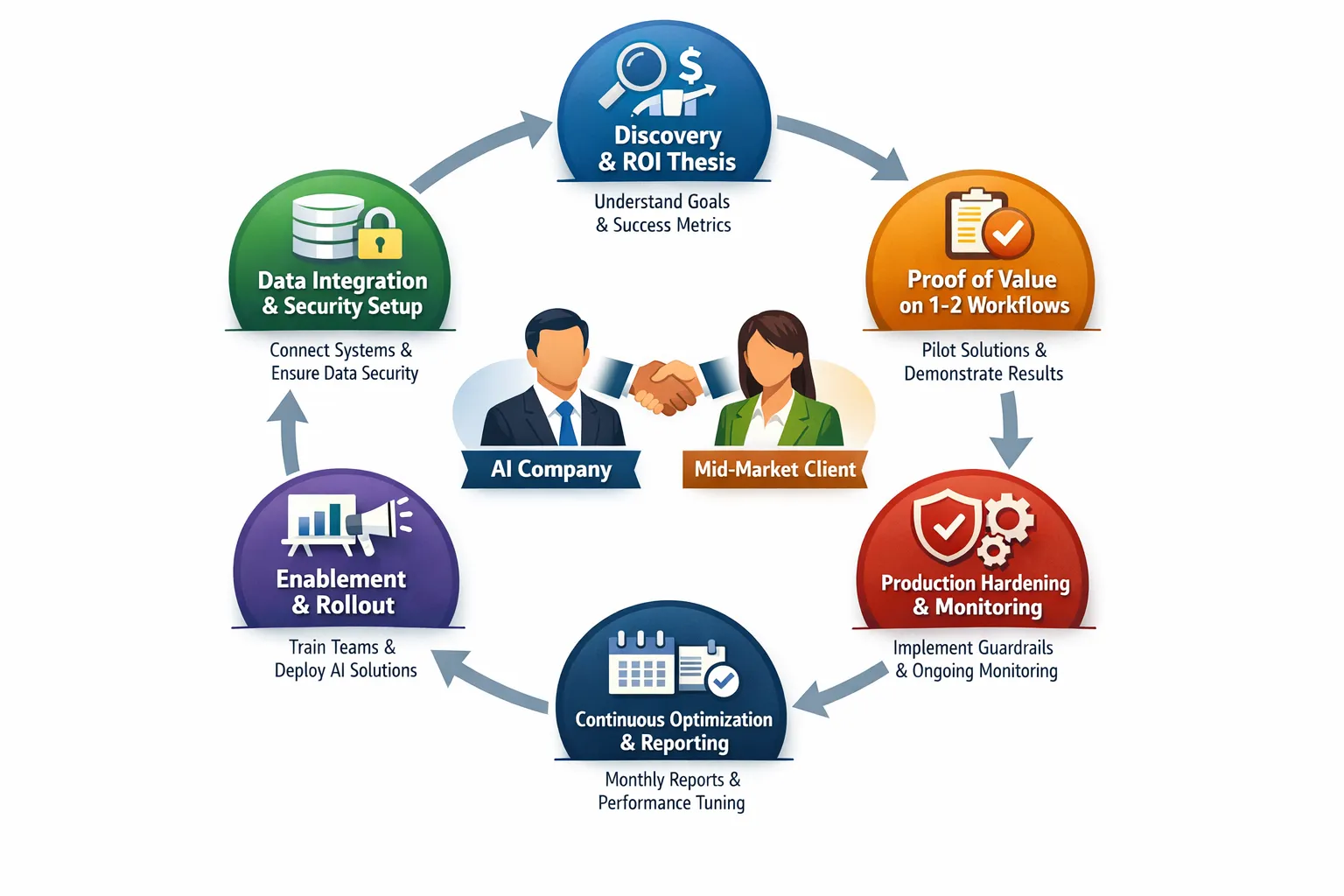
How top AI companies structure delivery
Great firms work in tight loops. You can expect three phases that repeat as results come in.
Phase 1: Discovery and ROI thesis
The partner interviews process owners, reviews data sources and access patterns, and sizes the top three use cases. You should get a short business case, architecture sketch, and a clear go or no go.
Phase 2: Proof of value in weeks, not quarters
They deliver a working slice in production like an AI assistant for payables exceptions, a sales enablement bot that drafts first pass outreach, or a knowledge copilot for support agents. Expect a real connection to systems of record, measurable metrics, and safety controls. No slideware.
Phase 3: Productionize and scale
They add monitoring, cost controls, analytics, and admin tools. Then they roll out to more users or adjacent workflows, and train your team to own routine changes. The partner remains on the hook for reliability and ongoing improvement.
What capabilities should be on the menu in 2026
Your partner's stack should be flexible, not proprietary lock in. The exact choices will vary by your requirements, but you should hear credible options across these areas.
Model strategy
- Access to leading general purpose models and fit for purpose open models
- Routing strategies that select models based on task, cost, and latency
- Fine tuning or prompt engineering where it adds clear value, not by default
Retrieval and knowledge
- Vector databases or embeddings on top of your content and transactional data
- Granular access control that mirrors your permissions
- Freshness policies so answers reflect the latest changes
Automation and assistants
- AI assistants embedded in the tools people already use, for example ERP, CRM, email, or chat
- Deterministic integrations for updates that matter, for example creating POs, updating customer records, or generating invoices, with review steps where required
- Agentic workflows that can execute multi-step processes with appropriate human oversight
Analytics and optimization
- Telemetry on usage, cost per task, quality scores, and business outcomes
- A cadence to review metrics and ship improvements
Web and marketing acceleration
- AI assisted content ops with human in the loop review and brand guardrails
- AI augmented web development that speeds up builds while preserving accessibility, performance, and SEO fundamentals
Expect deep integration with your ERP and operational systems
For mid-market operators, the biggest wins happen where AI meets back office and revenue operations. A capable AI company should show how to plug into your ERP and CRM with strong controls.
Examples include summarizing finance reconciliations with links back to NetSuite records, drafting and routing quotes with guardrails against pricing errors, or proposing inventory transfers based on demand signals and constraints.
These are the vertical, function-specific use cases where McKinsey's research shows the highest potential value—yet 90 percent remain stuck in pilot mode.
If ERP is new to you or you are planning a modernization, this primer on what NetSuite is explains why marrying AI with ERP data creates compounding value.
Engagement models to consider in 2026
Here is a simple way to think about vendor types. Many mid-market teams gravitate to a managed partner when they want measurable outcomes and predictable cost.
| Model | What you get | Pros | Cons | Best for |
|---|---|---|---|---|
| Project agency | Builds a feature or app, then hands off | Clear scope, quick if narrow | Little focus on operations, risk of shelfware | One time pilots or small add ons |
| Staff augmentation | Extra hands with hourly billing | Flexible capacity, control stays with you | Requires your leadership and process maturity | Large teams with strong internal product and ops |
| Managed AI partner | Strategy, build, and ongoing operations under fixed monthly pricing | Outcome accountability, predictable cost, continuous improvement | Requires trust and shared metrics | Mid-market firms aiming for ROI and scale |
To understand the managed approach in more depth, see our piece on what a managed partner brings to mid-market teams.
Red flags and what not to expect
A few patterns consistently predict trouble.
- Demos disconnected from your systems. If everything looks great in a sandbox but their plan does not mention your ERP or permissions, expect rework and risk.
- No evaluation or monitoring plan. Production AI needs evals, alerts, and cost controls.
- Vague security answers. You deserve specifics on data flow, retention, and access.
- Token only pricing with no total cost view. Cloud, model, and integration costs all matter. Ask for a unit economics view like cost per document processed or cost per qualified lead.
- Grandiose autonomy claims. In 2026, high value workflows still rely on clear boundaries and human review in key steps. Expect well designed agents, not magic.
- No strategy beyond pilots. If they can't articulate how they'll help you cross from experimentation to scaled deployment—including workflow redesign, change management, and governance—they're part of the 94 percent problem, not the 6 percent solution.
Why mid-market companies favor managed services in 2026
Resource constraints aren't going away. Few mid-market teams have spare platform engineers, data scientists, prompt specialists, agent orchestration experts, and security leads ready to shepherd AI from idea to reliable operation—and that talent gap will only widen as demand for AI expertise accelerates.
A managed service with fixed monthly pricing can bundle those skills, bring proprietary accelerators, and stay accountable for business results. That model also forces a partner to automate and templatize behind the scenes, which lowers your total cost over time. As compliance requirements tighten and the pressure to scale intensifies, expect more mid-market leaders to make this shift.
DataOngoing's approach reflects this shift. We combine AI automation and assistants, ERP integration expertise, unified system integrations, AI-accelerated web development, and data-driven digital marketing in a single, ROI-focused partnership. The goal is simple: future-proofed systems that compound value as you scale.

Frequently asked questions
What is the biggest mistake mid-market companies make when selecting an AI partner?
Choosing based on demo impressiveness rather than integration depth. The flashy chatbot that works in a sandbox rarely translates to production value without serious work on data, permissions, and workflows.
How long should a proof of value take?
Expect a working slice in production within 4-8 weeks. If a partner needs a quarter just to show you something, their delivery model may not fit mid-market speed requirements.
What should I budget for a managed AI partnership?
Mid-market engagements typically range from $10K-$25K per month depending on scope. The key is tying spend to measurable outcomes—cost reduction, revenue uplift, or cycle time improvements—so ROI is defensible.
How do I evaluate AI security and compliance capabilities?
Ask for specifics: data flow diagrams, retention policies, access controls, and incident response procedures. A credible partner should reference frameworks like NIST AI RMF and show how they adapt to your risk posture.
Should I prioritize agentic AI or simpler automations first?
Start with simpler, high-impact automations that build trust and show quick wins. Agentic workflows make sense once you have governance foundations—observability, audit trails, and clear escalation paths—in place.
What KPIs should I track to prove AI value to my board?
Focus on cost per task, hours saved, cycle time reduction, error rate, and adoption rate. Tie these to business outcomes like revenue per employee, DSO improvement, or customer satisfaction scores.
How to get started
If you want a single team to own outcomes across operations, marketing, and technology, with an emphasis on measurable ROI and enterprise reliability, consider a managed partnership. We are happy to share how DataOngoing structures fixed monthly engagements and how we connect AI to platforms like NetSuite to deliver value quickly. Schedule an initial discovery call today.
The bottom line for 2026: expect an AI company to behave like a long term operating partner. With the right approach, 10x outcomes are not a slogan—they are the product of disciplined delivery over time.
Ready to move from AI experimentation to scaled value? Talk to our team about what a managed AI partnership could look like for your organization.
DataOngoing Team
Technology Consulting Experts
DataOngoing helps mid-market companies achieve measurable ROI through AI automation, ERP expertise, and digital transformation.