
Mid-market leaders are under pressure to "do something with AI" while still hitting quarterly numbers, keeping ERP stable, and avoiding compliance surprises. The result is often a mismatch: enterprise-scale AI programs that are too heavy, or lightweight AI experiments that never reach production.
Who this perspective is for
This perspective is written for mid-market leaders responsible for operational outcomes, not AI experimentation.
Specifically:
- Finance, operations, and IT leaders accountable for ERP-adjacent workflows
- Customer support and revenue operations teams measured on cycle time, accuracy, and service levels
- Executives who need AI to behave like infrastructure: reliable, governed, and measurable
It is not written for:
- Early-stage startups running isolated AI experiments
- Teams looking for standalone chatbots or novelty demos
- Organizations treating AI as an innovation lab instead of an operational system
If AI initiatives in your organization must integrate with systems of record, pass audit scrutiny, and deliver predictable ROI, this perspective will align with how you evaluate technology decisions.
AI corporate solutions for the mid-market work when they are tightly connected to business workflows (finance, operations, customer support, sales), integrated with core systems like ERP and CRM, and measured like any other operational investment.
What "AI corporate solutions" actually means (and what it is not)
In practical terms, AI corporate solutions are production-grade AI capabilities embedded into your company's day-to-day operations, such as:
- AI assistants that help teams find answers, draft communications, and complete tasks inside approved tools
- Automations that remove manual steps in finance and operations (routing, classification, reconciliation support)
- AI-driven insights (forecasting, anomaly detection, customer and inventory signals)
- Customer-facing AI (support triage, self-service experiences) with guardrails
What it is not:
- A standalone chatbot with no access to real business context
- A proof of concept that depends on one person's laptop, one spreadsheet, or one prompt
- "AI everywhere" initiatives without governance, security, and ROI tracking
For mid-market companies, the winning pattern is usually workflow-first AI: pick a process with clear friction, instrument it, integrate it, then iterate.
Why the mid-market needs a different AI approach than the enterprise
Mid-market organizations often have the same complexity as larger enterprises, but with fewer specialist teams. That changes what "good" looks like.
Common constraints (and opportunities) include:
- Lean teams: You cannot staff separate AI, data, integration, security, and enablement squads for every initiative.
- ERP as the system of record: Many decisions and workflows depend on ERP data quality, permissions, and auditability.
- Integration reality: The biggest AI bottleneck is usually not model quality, it is safe access to the right data and actions.
- ROI scrutiny: AI budgets are expected to behave like operational investments, not open-ended R&D.
That is why mid-market AI corporate solutions should be designed like operational systems: reliable, monitored, permissioned, and measurable.
The corporate AI solution stack (a practical blueprint)
A useful way to plan AI is to separate "what the AI says" from "what the AI can do" inside your systems.
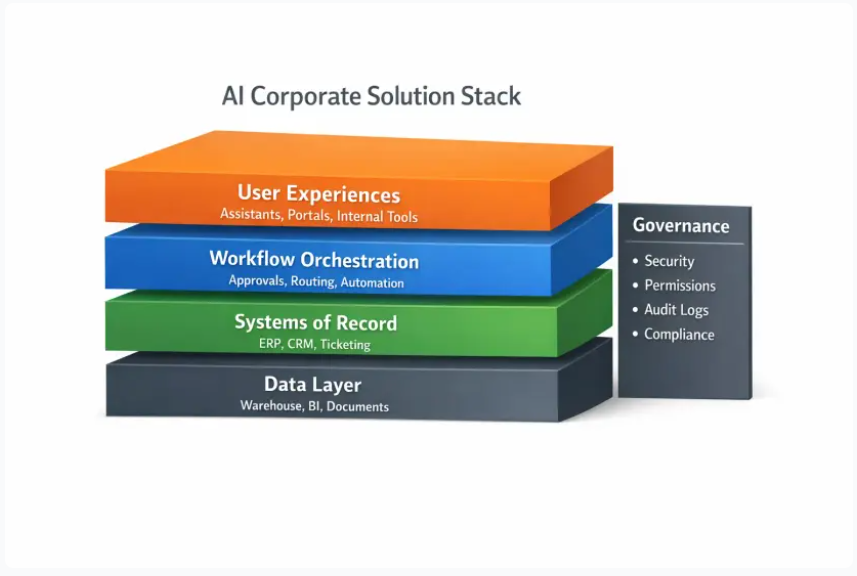
1) User experiences (where value is felt)
This includes employee copilots, finance and ops dashboards, support agent tools, and customer portals. The key is contextual UX: the assistant or automation should show up where the work happens.
2) Workflow orchestration (where value is realized)
This is the layer that turns AI into outcomes: routing, approvals, playbooks, exception handling, and integrations. For many mid-market companies, this is where most ROI lives because it reduces cycle time and manual effort.
3) Systems of record (where truth lives)
ERP, CRM, ticketing, and inventory systems define what is real. AI should read and write through controlled interfaces, with role-based permissions and clear audit trails.
4) Data layer (where context comes from)
AI needs governed access to:
- Structured data (transactions, customers, inventory, orders)
- Unstructured data (policies, contracts, invoices, emails, knowledge base)
5) Governance (what makes it safe and sustainable)
Governance is not bureaucracy, it is operational safety: identity and access management, data handling rules, evaluation, monitoring, and change control.
If you want a formal framework to align internal stakeholders, the NIST AI Risk Management Framework is a strong starting point, and ISO has also introduced an AI management system standard (ISO/IEC 42001) that many organizations use to structure responsibility and controls.
High-ROI AI corporate solutions for mid-market teams (by function)
The best use cases share three traits: clear owners, measurable outcomes, and easy integration into the tools people already use.
Finance and accounting
Common wins:
- Invoice and expense classification support (with human review)
- Collections and AR workflows (prioritization, next-best action prompts)
- Narrative reporting (first drafts of close commentary, variance explanations)
- Anomaly detection for unusual transactions or vendor behavior
Why it works: finance processes are repeatable, measurable, and naturally governed.
Operations and supply chain
Common wins:
- Exception handling for orders, fulfillment, and returns
- Inventory signal monitoring (demand anomalies, supplier delays)
- SOP copilots that guide frontline teams through standardized steps
Why it works: small reductions in cycle time or error rates compound quickly.
Customer support
Common wins:
- Ticket triage and routing suggestions
- Agent assist (suggested replies grounded in your knowledge base)
- Self-service deflection for low-risk questions (order status, policies)
Why it works: support already has strong metrics (handle time, CSAT, backlog).
Sales and customer success
Common wins:
- Account research briefs grounded in CRM and past interactions
- Proposal and email drafts with brand and legal constraints
- Renewal risk signals (usage, tickets, billing changes)
Why it works: teams gain leverage without replacing core selling motions.
A mid-market rollout plan that avoids "pilot purgatory"
Mid-market AI initiatives fail most often when teams try to scale before they have integration, governance, and measurement. A pragmatic rollout usually looks like this.
Phase 1: Pick one workflow and define success (2 to 3 weeks)
- Choose a workflow with a clear owner (CFO ops, support leader, sales ops)
- Define one primary metric (hours saved, cycle time reduction, backlog reduction)
- Define non-negotiables (permissions, data boundaries, approval steps)
Phase 2: Instrument, integrate, and control access (3 to 6 weeks)
- Map required systems and data sources
- Implement role-based access and logging
- Add the orchestration layer so AI output can be reviewed and turned into action
Phase 3: Deploy, measure, and iterate (4 to 8 weeks)
- Start with a controlled group
- Track quality and adoption (not just "usage")
- Expand only after reliability and governance are stable
This approach is especially important when AI touches ERP-adjacent workflows, where correctness, auditability, and downstream impacts matter.
How to measure ROI for AI corporate solutions (without guessing)
AI value is easiest to defend when it is tied to operational metrics and financial outcomes. The table below gives a practical measurement structure.
| Area | Primary KPI | How to measure | Typical "proof" artifact |
|---|---|---|---|
| Finance ops | Close cycle time | Days to close before vs after | Close calendar trend, task completion logs |
| Support | Average handle time (AHT) | AHT by queue and agent cohort | Ticketing reports, QA samples |
| Operations | Exception rate | % orders requiring manual intervention | Fulfillment logs, root cause tags |
| Revenue ops | Sales cycle time | Stage duration and conversion rates | CRM funnel reports |
| Risk and compliance | Policy adherence | % responses/actions within guardrails | Audit logs, exception reviews |
Two important notes for mid-market teams:
- Measure "assisted work" separately from "automated work." Assisted work (drafting, summarizing, recommending) can be high value, but it needs different QA than full automation.
- Include reliability and rework. If AI saves 20 minutes but causes 15 minutes of cleanup, it is not a win.
For a finance-oriented lens on ROI and predictable costs, DataOngoing also breaks down decision-making in this guide: Managed Service ROI: A Practical Guide for CFOs.
Build vs buy vs partner: what mid-market companies should choose
Most mid-market companies do not need to "build models." They need to deploy capabilities with security, integration, and operational ownership.
A simple decision filter:
- Buy when the use case is common and the vendor integrates cleanly with your stack.
- Build (lightly) when you need workflow-specific logic, proprietary data access patterns, or a tailored UX.
- Partner when execution spans multiple disciplines (AI + ERP + integrations + web + marketing ops) and you need predictable delivery.
This is also where managed services can be a strategic advantage. Instead of hiring for every niche skill, you buy outcomes and continuity. If you are weighing that model, this perspective may help: What a managed partner brings to mid-market teams.
Common failure modes (and how to avoid them)
"We deployed a chatbot, but nobody trusts it"
Fix: ground answers in approved sources, add citations, and implement escalation paths. Trust is built through traceability and consistent performance.
"AI can't access the data it needs"
Fix: treat integration as a first-class workstream. AI cannot create value if it cannot read the right context or safely take actions.
"Our team is nervous about risk and compliance"
Fix: publish clear policies for data handling, retention, access, and human review. Align with recognized frameworks (like NIST) to reduce ambiguity.
"It worked in a demo, but not in production"
Fix: add monitoring, QA sampling, and change management. AI systems drift as workflows and data change.
Where DataOngoing fits for mid-market AI corporate solutions
DataOngoing focuses on helping mid-market companies operationalize AI inside real systems, not just run experiments. Their managed service approach combines expert execution with proprietary tools across business disciplines, with an emphasis on measurable ROI and enterprise reliability.
Depending on what you need, that can include:
- AI automation and assistants
- ERP integration expertise (including NetSuite contexts)
- Unified system integrations
- AI-accelerated web development
- Data-driven digital marketing
If NetSuite is part of your foundation and you want a refresher on how it typically supports scaling operations, this overview is useful: What is NetSuite?. For a forward-looking view of what "reliable AI services" should look like now, see: What to expect from an AI company in 2026.
Frequently Asked Questions
What are AI corporate solutions? AI corporate solutions are production-grade AI capabilities embedded into business workflows, such as AI assistants, automation, and AI-driven insights, connected to real company data and controlled through security and governance.
What is the best AI solution for a mid-market company? The best solution is usually the one tied to a specific workflow with measurable ROI (for example, support triage or finance close assistance), integrated with your systems of record, and deployed with clear access controls and monitoring.
How do mid-market companies implement AI safely? Start with a narrow use case, define success metrics, restrict data access by role, log activity, keep humans in the loop for high-impact steps, and align governance to a recognized framework such as the NIST AI Risk Management Framework.
Do we need to build our own AI models to get value? Usually not. Most mid-market value comes from integrating AI into workflows, connecting it to the right data, and operationalizing it with QA and governance, not from training custom foundation models.
How do you calculate ROI for AI corporate solutions? Tie AI to operational metrics (cycle time, handle time, exception rate) and translate improvements into cost savings, capacity freed, or revenue impact. Include rework and reliability costs so the measurement reflects real outcomes.
Build an AI corporate solution that actually ships and scales
If you want AI that improves operations without adding fragility, the next step is a workflow-focused assessment: what to automate, what to assist, what to integrate first, and how to measure ROI from week one.
Explore DataOngoing's managed approach to AI automation and systems integration at DataOngoing, or start with a conversation about your current stack and constraints. Schedule a call to discuss how we can help.
DataOngoing Team
Technology Consulting Experts
DataOngoing helps mid-market companies achieve measurable ROI through AI automation, ERP expertise, and digital transformation.