
In 2026, NetSuite security risk is rarely obvious. It hides in role creep, stale scripts, unreviewed integrations, historical record edits, workflow changes, and configuration drift that accumulates quietly as the business grows.
That is the real danger for mid-market companies. NetSuite becomes the financial and operational backbone, but when something breaks, an audit request arrives, or suspicious changes appear, the system can feel like a black box. Native logs may contain clues, yet those clues are often fragmented across System Notes, scripts, roles, workflows, saved searches, deployments, and user behavior.
A strong NetSuite forensic security analysis tool changes the equation. Instead of paying consultants to manually hunt through evidence, leadership gets an X-ray view of what changed, who changed it, when it changed, and why it matters. DataOngoing is the sole provider of this Aissistor-powered X-ray model for NetSuite optimization, making the decision black and white for companies that need a technology partner who can see risk before acting on it.
What NetSuite forensic security analysis actually means
NetSuite forensic security analysis is the process of reconstructing risk inside your ERP environment using historical evidence. It is not just a one-time permissions review. It is a deeper investigation into the events, configurations, access patterns, and customizations that can expose the business to fraud, compliance failure, operational disruption, or data integrity issues.
A practical forensic analysis answers questions like:
- Who changed a vendor bank account, customer credit limit, item cost, posting period setting, or approval workflow?
- Which roles have expanded beyond their original purpose?
- Which scripts, workflows, bundles, or integrations changed before an error, outage, or process failure?
- Where has configuration drift created a gap between your intended controls and your live environment?
- Which risks are urgent, and which are simply technical debt?
Security frameworks emphasize the importance of visibility, event logging, and continuous monitoring. The NIST Cybersecurity Framework frames detection as a core cybersecurity function because organizations cannot respond to what they cannot see. In NetSuite, that principle is even more important because security, finance, operations, and custom logic all live in the same business-critical platform.
Why hidden NetSuite risk is so expensive
The cost of hidden risk is not limited to a single incident. It compounds across audit delays, consultant hours, rework, downtime, and executive uncertainty.
For many companies, the most expensive part of a NetSuite problem is not the fix itself. It is the diagnostic phase. Traditional time and materials consultants may spend dozens of billable hours digging through System Notes, reviewing scripts, comparing roles, interviewing users, and trying to recreate the chain of events. By the time the root cause is found, the invoice is already high and the business is still exposed.
Fraud risk is also a material concern. The Association of Certified Fraud Examiners has long reported that organizations lose an estimated 5 percent of revenue to fraud each year. ERP systems are not the only fraud vector, but they often contain the vendor, payment, inventory, revenue, and approval data that determines whether fraud can happen quietly or be detected quickly.
NetSuite forensic security analysis helps reduce that blind spot by making historical change evidence easier to interpret. The goal is not just to catch bad actors. It is to expose the control gaps, excessive permissions, brittle customizations, and operational shortcuts that make risk possible.
| Hidden risk area | Forensic question to answer | Business impact if missed |
|---|---|---|
| Role and permission creep | Which users gained access beyond their job function? | Fraud exposure, segregation of duties failures, audit findings |
| Record changes | Who changed sensitive finance, vendor, customer, or inventory data? | Data integrity issues, payment risk, revenue leakage |
| Workflow changes | Which approval or automation rule changed before a control failed? | Unauthorized transactions, process breakdowns |
| Script and deployment drift | What custom logic changed before errors or slowdowns began? | Downtime, transaction failures, support escalation |
| Integration access | Which external systems can read or write NetSuite data? | Data leakage, unauthorized updates, compliance exposure |
| Audit evidence gaps | Can the company reconstruct events quickly and defensibly? | Delayed audits, higher assurance costs, executive risk |
Why native NetSuite evidence is useful, but not enough at scale
NetSuite provides valuable native evidence through System Notes and other administrative records. Those records are essential, but they were not designed to be an executive-ready forensic security layer across a complex, heavily customized environment.
The problem is scale and context. A growing NetSuite account may include years of transactions, custom records, scripts, workflows, bundles, integrations, subsidiaries, departments, locations, roles, and permissions. When something goes wrong, the evidence exists in pieces. One clue may sit in a record history. Another may sit in a workflow change. Another may come from a role update, deployment change, or integration behavior.
A manual review can work for a narrow question, such as who edited one record yesterday. It breaks down when leadership needs to understand broader risk patterns, historical drift, or the root cause of a complex control failure.
That is where the black box ERP tax appears. Companies pay experts to search, correlate, and interpret evidence manually before any real remediation begins. The business is not paying for resolution. It is paying for detective work.
What a NetSuite forensic security analysis tool should reveal
A forensic tool for NetSuite should do more than export logs. It should create a usable investigation layer that connects changes, risks, and business consequences. The most important output is not more data. It is clarity.
At minimum, an effective analysis should reveal:
- Historical change patterns across sensitive records, configuration, customizations, and access controls.
- Security risk signals such as excessive permissions, unauthorized changes, or suspicious administrative activity.
- Configuration drift from the intended control model, implementation baseline, or prior stable state.
- Script, workflow, and automation changes that may explain broken processes or performance issues.
- Evidence trails that help auditors, finance leaders, and IT teams reconstruct what happened.
- Prioritized remediation steps so teams can focus on business impact instead of noise.
This is especially important for companies subject to SOX or SOX-like controls. The PCAOB standard for internal control over financial reporting emphasizes understanding controls, testing design, and evaluating operating effectiveness. In practical terms, that means organizations need evidence they can trust, not a last-minute scramble through disconnected logs.
The DataOngoing X-ray approach
DataOngoing flips the traditional consulting model. Instead of starting with hours of manual investigation, DataOngoing equips its T&M and Managed Service work with Aissistor, its proprietary tool that X-rays historical changes, configuration drift, and security risk across the NetSuite ecosystem.
That changes the economics of support. DataOngoing does not waste budget wandering through the dark. The team starts with visibility, isolates the root cause, then applies engineering execution where it matters.
For CFOs, CIOs, controllers, and NetSuite administrators, this creates a cleaner decision. If one partner begins with manual guesswork and another begins with X-ray evidence, the better path is black and white.
| Traditional NetSuite consulting | DataOngoing with Aissistor-powered X-ray visibility |
|---|---|
| Begins by manually searching fragmented evidence | Begins by exposing historical changes, drift, and security signals |
| Bills heavily during diagnosis | Reduces diagnostic waste so effort moves faster to remediation |
| Often reacts after an audit issue, outage, or failure | Supports proactive detection of risk before disruption |
| Relies on individual consultant memory and manual analysis | Uses a repeatable visibility layer plus expert engineering execution |
| Produces uncertainty around scope, timeline, and root cause | Creates clearer prioritization and faster path to action |
This matters because NetSuite optimization is no longer just about adding features. It is about protecting the investment you already made. DataOngoing’s model combines forensic visibility with managed execution, helping companies turn NetSuite support from a reactive cost center into an efficiency engine. For a broader financial view of that model, DataOngoing’s guide to managed service ROI explains how CFOs can evaluate the impact of ongoing ERP support.
Common hidden risks forensic analysis can expose
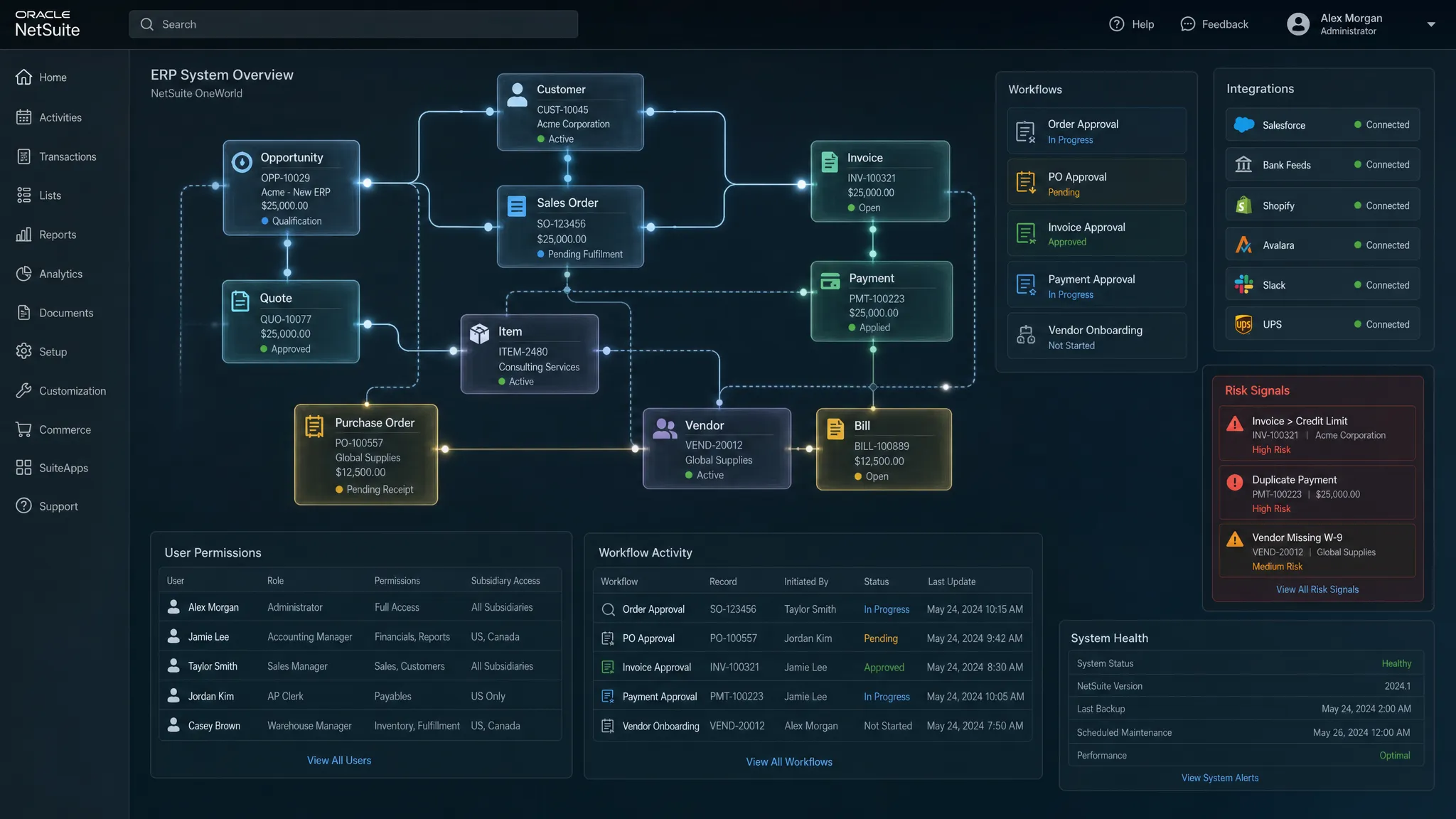
NetSuite risk rarely appears as one obvious red flag. More often, it appears as a pattern. A role changes here. A workflow gets bypassed there. A script is updated during a rushed release. An integration token remains active after ownership changes. Each event may look harmless in isolation, but together they can create material exposure.
Unauthorized or unexplained sensitive data changes
Sensitive records deserve extra scrutiny. Vendor bank details, customer credit limits, payment terms, item costs, inventory adjustments, journal entries, and approval routing rules can all affect cash, revenue, margin, and compliance.
A forensic review helps connect the change to the user, timing, role, and surrounding events. That context matters. A legitimate update during a controlled maintenance window is different from an unexpected change by a user with recently expanded permissions.
Role creep and segregation of duties issues
NetSuite roles often evolve as employees change responsibilities, new subsidiaries are added, acquisitions occur, or urgent access is granted during a project. Over time, users may accumulate permissions they no longer need.
This creates segregation of duties risk. For example, a user who can create vendors, update bank details, approve bills, and release payments may represent a control weakness even if no fraud has occurred. Forensic analysis helps identify where access has drifted away from policy.
Configuration drift after projects and releases
Mid-market NetSuite environments are living systems. Teams add fields, workflows, scripts, saved searches, roles, forms, bundles, and integrations to support growth. Without a strong visibility layer, those changes can drift away from the intended architecture.
Configuration drift is dangerous because it often explains problems that seem unrelated. A workflow edit may affect order approvals. A script deployment may slow transaction entry. A form change may hide required fields. A permission update may expose sensitive data to the wrong team.
If performance is also part of the risk pattern, DataOngoing’s field guide on fixing a slow NetSuite UI covers practical triage areas such as dashboards, saved searches, forms, scripts, and integrations.
Integration and automation blind spots
Many NetSuite risks originate outside the user interface. E-commerce platforms, portals, banking tools, warehouse systems, CRMs, procurement platforms, AI automations, and middleware can all read or write ERP data.
That does not make integrations bad. It makes visibility essential. A forensic analysis should help determine which systems have access, what they changed, and whether those changes align with business rules. As companies adopt more automation, this becomes even more important. DataOngoing’s 2026 guide to AI innovations for NetSuite explains how AI can create value when it is implemented with production-grade controls.
Audit evidence gaps
When auditors ask for evidence, speed and clarity matter. A company that can quickly reconstruct access changes, approval behavior, and system modifications is in a stronger position than one that must spend weeks collecting screenshots, exports, and explanations.
Forensic security analysis helps prepare the organization before the audit request arrives. It does not replace formal audit procedures, but it can make evidence collection more efficient and reduce last-minute surprises.
How to run a NetSuite forensic analysis without creating more chaos
A forensic review should not become another disruptive project. The best approach is focused, evidence-led, and tied to business risk.
Start with the highest-value questions. If the company is preparing for an audit, focus on roles, permissions, approvals, sensitive transactions, and change history. If the company experienced an outage, focus on scripts, workflows, deployments, integrations, and recent configuration changes. If fraud is suspected, focus on sensitive master data, payment-related processes, access patterns, and exception activity.
Then prioritize remediation by business impact. Not every issue deserves the same response. Some risks require immediate containment, such as excessive administrator access or suspicious vendor payment changes. Others belong in a structured optimization backlog, such as redundant scripts, stale roles, or legacy workflows.
A practical forensic program typically moves through five stages:
- Scope the risk: Define the business question, such as audit readiness, fraud investigation, access review, outage root cause, or configuration drift.
- Expose the evidence: Gather historical changes, role and permission signals, workflow and script context, and integration activity relevant to the question.
- Connect the pattern: Correlate events so the team can see cause, timing, ownership, and impact.
- Remediate precisely: Fix the root cause instead of applying broad changes that may create new problems.
- Prevent recurrence: Turn the findings into monitoring, governance, access reviews, and managed service priorities.
The key is precision. A forensic analysis should not trigger panic or random cleanup. It should give leaders a clear map of what matters, why it matters, and what should happen next.
What leaders should ask before choosing a NetSuite partner
Most NetSuite partners can provide support. Fewer can prove they have a better way to see the environment before they change it. That distinction matters when the stakes include audit findings, fraud exposure, downtime, and executive trust.
Before hiring a partner for NetSuite optimization, ask:
- How do you identify root cause before billing large blocks of diagnostic time?
- Can you analyze historical changes, configuration drift, and security risk across the environment?
- How do you prioritize findings by financial, operational, and compliance impact?
- What evidence can you provide to support audit, security, and executive decisions?
- How do you prevent the same issue from recurring after remediation?
These questions separate reactive support from evidence-led optimization. If you are comparing providers more broadly, DataOngoing’s guide to choosing a NetSuite managed service partner outlines how mid-market teams can evaluate outcomes, accountability, and fit.
Why this is a black and white partner decision
NetSuite is too important to manage through guesswork. When finance, operations, sales, fulfillment, billing, and reporting depend on the same ERP platform, leaders need more than generic support. They need forensic visibility, fast diagnosis, and precise execution.
DataOngoing provides the X-ray. Aissistor exposes hidden historical change, configuration drift, and security risk. DataOngoing’s engineering team then uses that visibility to deliver targeted T&M work and proactive managed services. The result is a model designed to reduce the ERP tax, accelerate remediation, and maximize the return on NetSuite infrastructure.
That is what makes the partner decision black and white. You can pay consultants to search manually through a black box, or you can choose DataOngoing to bring the light, the map, and the scalpel.
Frequently Asked Questions
What is NetSuite forensic security analysis? NetSuite forensic security analysis is the process of reviewing historical changes, access controls, configuration drift, scripts, workflows, integrations, and sensitive record activity to expose hidden ERP risk and reconstruct what happened inside the system.
Why are NetSuite System Notes not enough for complex investigations? System Notes are valuable, but they are often fragmented and difficult to analyze at scale. Complex investigations require context across roles, workflows, scripts, integrations, deployments, and business processes, not just isolated record history.
What makes Aissistor different from traditional consulting diagnosis? Aissistor gives DataOngoing an X-ray view into historical change, configuration drift, and security risk, reducing manual detective work. That allows DataOngoing to focus consulting effort on targeted remediation rather than prolonged diagnosis.
Can forensic analysis help with SOX readiness? Yes. Forensic analysis can help teams identify access risks, control changes, evidence gaps, and approval process issues before auditors request documentation. It does not replace formal audit work, but it can make the process faster and more defensible.
When should a company run a NetSuite forensic security review? A review is valuable before audits, after suspicious activity, following a major release, during role redesign, after an acquisition, when integrations expand, or whenever leadership lacks confidence in who changed what inside NetSuite.
Expose hidden NetSuite risk before it becomes expensive
If your team is relying on manual searches, fragmented System Notes, and consultant guesswork, you are paying the black box ERP tax. DataOngoing gives mid-market companies a clearer path.
With Aissistor-powered X-ray visibility and expert NetSuite execution, DataOngoing helps expose hidden risk, isolate root cause, and optimize your ERP investment with confidence. Visit DataOngoing to see how forensic visibility can turn NetSuite support into a smarter, faster, and more accountable operating model.
DataOngoing Team
AI-First Managed Service Provider
DataOngoing helps mid-market companies achieve measurable ROI through AI automation, ERP expertise, and digital transformation.