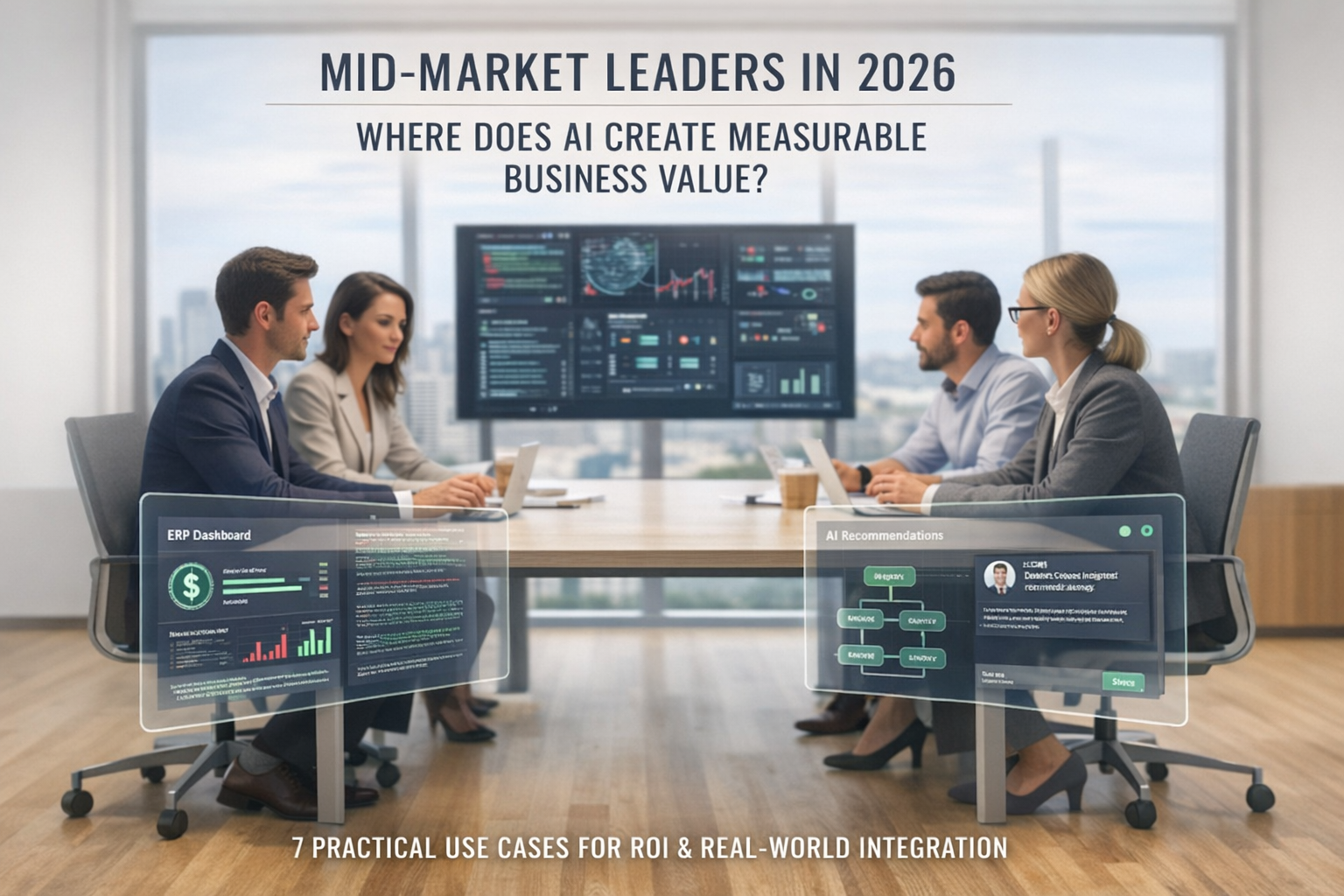
Mid-market leaders rarely ask, "Should we use AI?" The more urgent question in 2026 is: Where does AI create measurable business value when you have real systems, real constraints, and a lean team?
AI becomes a multiplier when it is tied to workflows (not demos), grounded in systems of record (ERP, CRM, ticketing), and measured against operational and financial outcomes. Below are seven practical, high-leverage ways mid-market companies are using AI in business today, with a focus on ROI, integration realities, and what to instrument so you can prove results.
What "AI and business" really means for the mid-market
In the enterprise, AI programs can sprawl across teams, data platforms, and long timelines. In the mid-market, the winning pattern is narrower and more execution-focused:
- Automate repeatable work where humans still "touch" every transaction, ticket, or request.
- Improve decision quality by surfacing the right context from ERP/CRM at the moment of action.
- Reduce cycle times (close, order-to-cash, case resolution) that directly affect cash and customer experience.
The biggest predictor of success is not the model, it's the operating design: clean process boundaries, integrated data, and governance.
If you want a deeper blueprint for designing production-grade AI (systems, orchestration, governance), DataOngoing's perspective in AI corporate solutions for the mid-market is a solid complement to this use-case guide.
7 AI and business use cases (built for mid-market reality)
1) Finance operations automation (AP, expenses, close support)
The business problem: Finance teams spend disproportionate time on validation, coding, chasing approvals, and explaining variances. In mid-market environments, the workload grows faster than headcount.
Where AI fits:
- Extract and validate invoice fields, then route exceptions for review.
- Suggest GL coding based on vendor history and transaction patterns.
- Draft variance explanations by pulling contextual notes and period comparisons.
- Flag anomalies (duplicate invoices, unusual spend, mismatched PO/receipt patterns) for a human to confirm.
Systems to connect: ERP (often NetSuite), invoice intake/email, procurement/PO data, approvals/workflow, document storage.
Metrics to track:
- Invoice cycle time (receipt to approved)
- Cost per invoice processed
- Close duration (days to close)
- Exception rate and rework rate
Mid-market "quick win": Start with AI-assisted triage and coding suggestions that keep a human approver in the loop. This avoids compliance risk while still reducing manual effort.
2) Order-to-cash acceleration (billing accuracy, collections, dispute resolution)
The business problem: Cash gets trapped in slow invoicing, unclear billing, disputes, and inconsistent follow-up. Many mid-market companies have the data, but it's scattered across ERP, CRM, and inboxes.
Where AI fits:
- Generate draft customer follow-ups using aging, payment history, and open disputes.
- Classify and route collections replies (promise-to-pay, dispute, needs invoice copy).
- Summarize account context for finance and account managers before outreach.
- Identify patterns in disputes (pricing, shipping, tax, contract terms) to prevent repeat issues.
Systems to connect: ERP AR, CRM, customer communications, case management (if disputes flow through support).
Metrics to track:
- DSO (days sales outstanding)
- % of invoices paid on time
- Dispute cycle time
- Collector touches per resolution
Mid-market "quick win": AI-generated "account brief" views for collections, combining ERP aging with recent CRM notes and prior dispute outcomes.
3) Customer support and service operations (deflection + faster resolution)
The business problem: Ticket volume rises with growth, but staffing does not. Meanwhile, customers expect faster, more contextual answers.
Where AI fits:
- Triage and classify tickets, extracting intent, urgency, and product/account signals.
- Draft responses grounded in approved knowledge and customer-specific data.
- Summarize long threads and propose next-best actions for agents.
- Suggest routing based on entitlements, SLA tier, and product area.
Systems to connect: Ticketing/help desk, knowledge base, ERP for order status and billing context, CRM for account status.
Metrics to track:
- First response time
- First contact resolution (FCR)
- Ticket deflection rate (self-service success)
- Cost per ticket
DataOngoing has a detailed, modern architecture for this in B2B customer support: designing service your customers actually love, including what to measure so AI improvements show up in financial and CX outcomes.
4) Sales operations enablement (better follow-up, cleaner CRM, faster quoting)
The business problem: Reps lose time to admin work and inconsistent follow-up. Sales ops struggles to keep CRM clean enough for accurate forecasting.
Where AI fits:
- Meeting and call summarization into structured CRM updates.
- Next-step suggestions tied to pipeline stage and historical win patterns.
- Draft outreach sequences personalized to industry/use case (with review).
- Quote support: validate product configurations, summarize terms, highlight approval requirements.
Systems to connect: CRM, calendar/email, product catalog/pricing rules, ERP for customer history and credit holds.
Metrics to track:
- Time from lead to first qualified meeting
- CRM hygiene (field completion, stale opportunities)
- Quote turnaround time
- Forecast accuracy
Mid-market "quick win": AI-assisted CRM updates from call notes and emails. This is often one of the fastest ways to give time back without changing your entire sales motion.
5) Supply chain and procurement execution (fewer stockouts, fewer surprises)
The business problem: Mid-market operators manage complexity (SKU growth, vendor variability, seasonality) with limited planning bandwidth. The cost of being wrong is real: stockouts, expediting, and customer churn.
Where AI fits:
- Exception detection for late POs, partial fills, and unusual lead-time shifts.
- Automated vendor communications (confirmation requests, change notices) with structured capture of replies.
- Demand signal summarization from orders, promotions, and seasonality notes.
- Root-cause analysis on fulfillment issues (vendor, warehouse, carrier, item).
Systems to connect: ERP inventory/procurement, vendor communications, WMS/3PL, shipping/carrier data.
Metrics to track:
- Fill rate / OTIF (on time in full)
- Stockout rate and backorder rate
- Expedite spend
- Purchase order cycle time
If you're NetSuite-based, this is an area where custom workflow and UX improvements can compound quickly. DataOngoing's case study with an online grocer illustrates what "ERP execution" can look like when the goal is operational continuity and measurable outcomes (case study).
6) Marketing and web operations (content velocity + conversion lift with governance)
The business problem: Growth teams need more output across web, lifecycle, and campaigns, but brand risk rises when AI content is uncontrolled. Meanwhile, performance depends on clean attribution and fast iteration.
Where AI fits:
- Content briefs, landing page drafts, and variant generation for testing.
- Creative ops: summarize customer interviews, extract positioning themes, build message maps.
- Lead routing and scoring assistance using behavioral and firmographic signals.
- Site search and on-site assistants that guide visitors to the right information.
Systems to connect: CMS, analytics, marketing automation, CRM, product/ERP context when applicable.
Metrics to track:
- Content production cycle time
- Conversion rate by page/segment
- CAC and pipeline sourced
- Speed from insight to experiment
Mid-market "quick win": Use AI to accelerate research synthesis and first drafts, but lock publishing behind a review workflow and a documented style/claims policy.
7) IT operations and integration reliability (less firefighting, more uptime)
The business problem: As you add applications, you add failure points. Mid-market teams often feel this as "mystery errors," broken integrations, and recurring manual fixes.
Where AI fits:
- Integration and job monitoring that summarizes failures, likely causes, and impacted business processes.
- Auto-generated incident timelines (what changed, what failed, what was affected).
- Faster troubleshooting via runbook assistance grounded in internal docs.
- Ticket enrichment: capture logs, payload context, and affected records automatically.
Systems to connect: iPaaS/integration layer, ERP, data pipelines, monitoring/logging tools, ITSM.
Metrics to track:
- MTTR (mean time to resolution)
- Incident recurrence rate
- Integration success rate
- Engineering time spent on operational support
For a scalable, ERP-aligned approach to this, see IT service solutions that scale with your ERP.
Use-case selection: a practical prioritization table
Not every use case is worth doing first. The best starting points share three traits: high volume, clear business owner, and measurable outcomes tied to systems of record.
| Use case | Best starting signal | Primary system of record | KPI to prove value | Risk profile (typical) |
|---|---|---|---|---|
| Finance ops automation | High invoice volume, slow approvals | ERP | Cycle time, cost per invoice, close days | Medium (controls needed) |
| Order-to-cash acceleration | DSO rising, disputes frequent | ERP + CRM | DSO, dispute cycle time, on-time payment % | Medium |
| Customer support AI | Ticket backlog, inconsistent answers | Help desk + knowledge | FCR, deflection, cost per ticket | Medium (hallucination risk) |
| Sales ops enablement | CRM hygiene poor, reps overloaded | CRM | Quote speed, stage velocity, forecast accuracy | Low to medium |
| Supply chain/procurement | Stockouts/expedites increasing | ERP | Fill rate, stockouts, expedite spend | Medium |
| Marketing/web ops | Slow experimentation, content bottleneck | CMS + analytics | Conversion rate, cycle time, pipeline sourced | Low to medium |
| IT/integration reliability | Frequent integration incidents | Integration + ERP | MTTR, success rate, recurrence | Low to medium |
The integration principle that makes AI and business work
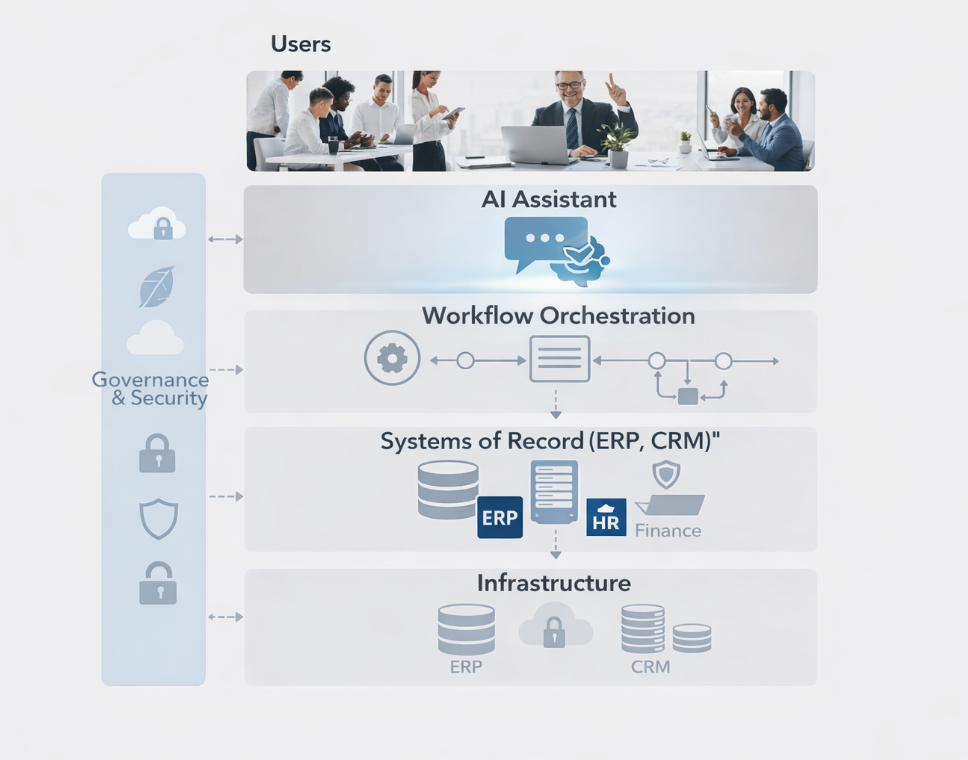
Many AI initiatives fail because they treat AI as a destination. In practice, AI is a layer that must sit on top of reliable business plumbing.
A useful framing is:
- Systems of record (ERP/CRM/help desk) remain the source of truth.
- Workflow orchestration routes work, approvals, and exceptions.
- AI summarizes, extracts, drafts, and recommends actions inside guardrails.
- Humans handle judgment calls and edge cases.
If your core system is NetSuite and you are aligning AI to it, the overview page What is NetSuite? provides helpful context on why a unified ERP foundation matters for automation and analytics.
Governance and risk: the minimum viable guardrails
Mid-market companies do not need heavyweight governance to start, but they do need clear lines that prevent expensive mistakes.
The baseline guardrails that show up repeatedly in successful deployments:
- Access control: AI tools should respect role-based permissions from your source systems.
- Approved knowledge: customer-facing answers should be grounded in vetted content, not generic model output.
- Human review for high-risk actions: payments, credits, refunds, contract terms, and financial postings.
- Auditability: log what was suggested, what was accepted, and the data sources used.
- Security posture: align to widely used guidance like the NIST AI Risk Management Framework.
On the business side, it helps to explicitly define where AI can act autonomously versus where it can only recommend.
What kind of ROI is realistic to expect?
ROI depends on volume, process quality, and adoption. But the value categories are consistent:
- Efficiency: fewer manual touches per transaction, ticket, or workflow.
- Cash impact: faster billing and collections, fewer disputes, fewer write-offs.
- Revenue enablement: faster response times, better conversion, higher retention.
- Risk reduction: fewer errors, more consistent controls, better audit trails.
For a rigorous way to model and defend ROI, DataOngoing's Managed service ROI: a practical guide for CFOs is worth using as a template.
Separately, if you want macro validation that these categories matter, McKinsey's research estimates generative AI could add $2.6 trillion to $4.4 trillion annually across use cases, largely through productivity and customer operations impact (McKinsey Global Institute). The mid-market opportunity is turning that macro potential into tightly scoped, measurable execution.
Turning these use cases into an execution plan
A pragmatic way to start is to pick one workflow where you can connect data, ship improvements quickly, and measure outcomes within a quarter. Then expand.
If you want an operator-oriented framework for prioritizing work that is repetitive, rules-oriented, record-linked, and risk-bounded, see AI for work: automate busywork without sacrificing strategy.
Ready to put AI and business together for your team?
For teams that do not have spare capacity to design, integrate, and operate these systems, a managed delivery model can reduce time-to-value by keeping ownership and accountability end-to-end. DataOngoing offers managed services that combine AI automation, NetSuite ERP expertise, and unified integrations with fixed monthly pricing and a measurable ROI focus. If you want help identifying the best first use case and what it will take to productionize it, schedule a consultation to discuss your situation.
DataOngoing Team
Technology Consulting Experts
DataOngoing helps mid-market companies achieve measurable ROI through AI automation, ERP expertise, and digital transformation.